Tuesday, March 17, 2020

It's Maple Syrup Season!

Maple Syrup season is upon us. The Alvinston Maple Syrup Festival is cancelled this year due to cautions surrounding the Coronavirus outbreak.  Tapping trees to make Maple Syrup has been been a rite of spring for hundreds of years in North-eastern North America.
Many legends help to explain the discovery of Maple Syrup. But Indigenous people may have learned about the sweet sap after observing birds and animals drinking sap from cracks in tree bark. Tasting a frozen "sapsicle" from a Sugar Maple tree can be surprisingly sweet!

  Our indigenous populations heated rocks in a fire and placed
 the hot rocks in hollowed, sap filled tree logs to evaporate water.

Sugar Maple trees are reflected in the drip of sap leaking from the spile. When sap drips from the tree it is 3% sugar, on average  The ratio of sap to syrup is 40:1. Forty litres of sap must be collected to get enough sugar to make just 1 litre of maple syrup!

Early Pioneers boiled sap to remove water through evaporation. 
Cast iron pots allowed for a hotter fire to evaporate the water and create 
a sweeter, lighter coloured syrup, as compared to the hot rock method.

Metal pails are stored in the Sugar Shack during the off season.

Many advancements have improved the quality of syrup, including the use of plastic equipment. One tap hole will produce 40 litres of sap in an average season. By counting the tap holes in a sugar bush, you can estimate how much syrup will be produced.

Tourists from around the globe have toured the A. W. Campbell Sugar Bush.

Photo Booth!

A quaint ride along the forest road.

So much steam! When sap is boiled, water evaporates 
until the sugar density is 66% sugar.

Boiling syrup for taffy

Ready to pour on ice!

Yum!!

Sunday, March 15, 2020

Spring Break 2020

The flowers on our Silver Maple Tree are opening!  Spring must be getting closer! I hope the kids who will be off school for 3 weeks get lots of opportunities to spend time outside and enjoy the beauty of nature!

Yesterday, Deryl found his first Meadowlark of the year. (above). We returned to the landfill trails today and found 2 pairs, but none of them were willing to have their picture taken.

We did end up with an unexpected view of 3 Short-eared Owls
 that had been resting on the ground and took to the air when they saw us.

The most I could get in one shot were 2 owls.

This afternoon, 2 Carolina Wrens were feeding in our backyard. 
They had to wait for the Downy Woodpecker to have his fill first.
Taken through a glass window and screen.


We have regularly been finding and hearing the trill of 
Red-bellied Woodpeckers in the forest.

Ring-necked Ducks (which I think are misnamed as they are easiest to identify 
by looking for the ring around the bill and not the neck) have been 
showing up recently in Lake Chipican.


Sunday, March 8, 2020

More Weekend Things!

Luckily our morning didn't start off on a smelly note.  This skunk was scavenging a few houses down investigating a bag of "unknown's" outside a neighour's front door.  I stayed on the road, but when he stood on his front feet, basically doing a hand stand, I took my cue and left.

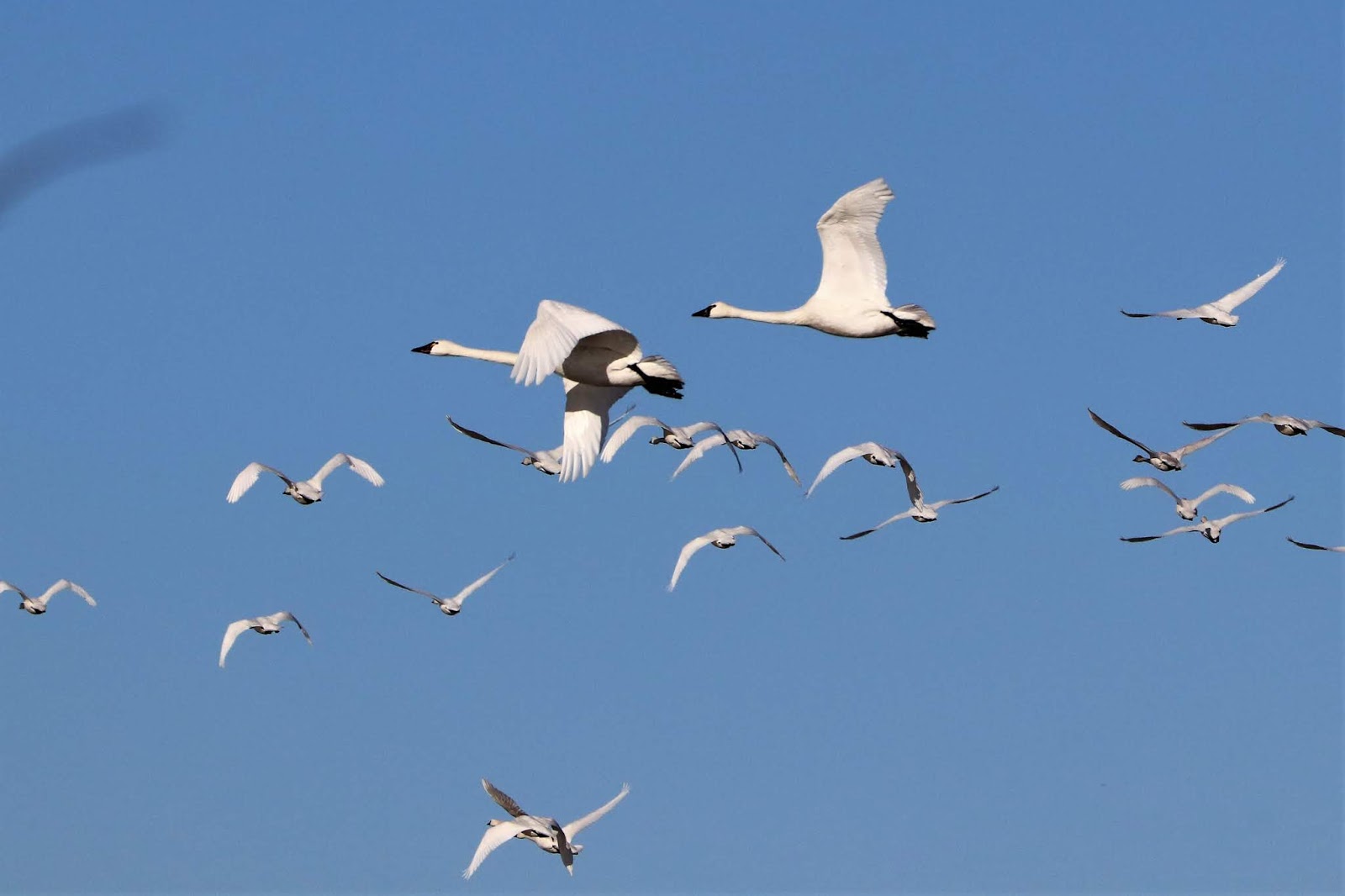
We headed to North Lambton and caught up with some of the Tundra Swans that we saw yesterday.  This group was at the Forest Lagoons, but we saw thousands more at the onion fields near the Lambton Heritage Museum.  One e-birder reported 21,000 birds today!  

Last night we walked to the Canatara meadow in hopes of finding a Woodcock.  We eventually found one 25 minutes after sunset.  I entertained myself by taking photos of the moon while waiting.

We found 40 Robins in Tarzanland yesterday afternoon. They were busy looking for bugs in the wet mud.

A Red-bellied Woodpecker peeks his head out of his sheltered house.

We watched this little chickadee inspect the light bulbs on one of the 
Christmas displays. The light fixtures are possibly a source of hidden bugs.

Grackles are back!  Now my bird feeders will need to be refilled more often.

A Bald Eagle surprised us when it zoomed past on the Burley Bridge at the Pinery.  I had been photographing a muskrat and we wonder if the Eagle was thinking about a little muskrat snack, then changed his mind when he saw us.


Saturday, March 7, 2020

1500 Hundred Swans and a Goose or Two!!

My week began by learning something new about Canada Geese. The Geese were making a cacophony of sounds as they began the process of defending their territory around the edges of Lake Chipican.  One particular goose decided to confront me (although I was on the trail and he was in the water.)  I snapped some photos of his head and when I looked at the photos on the computer, I could see serrated edges on both sides of the tongue.  A quick google search informed me that the serrated tongue assists in draining water from the mouth when feeding under water.  Its cool to learn something new! (If you click on the photo to enlarge it, hopefully you can see the serrated edge.)

This morning we went in search of Ducks along the Suncor Trail. The trail was extremely quiet, but we found 1500 Tundra Swans once we crossed the bridge to Wawanosh Wetlands!  We walked to the look out tower and despite the phragmites, were able to see many of the birds.

There was continual movement of the swans.

We believe they spent the night at Wawanosh 
now that the water is open and mostly free of ice.

This pair of birds appeared to be having an argument 
as the back bird kept biting the wing of the one in front.

Sometimes Canada Geese would take flight with the swans.

Most of the swans were heading east as they left the wetlands, perhaps on their way to the onion fields in North Lambton where they rest during their northward migration.


It was a joy to listen to them call as they flew overhead!
A great way to start the weekend!

Sunday, March 1, 2020

March 1, 2020

I mentioned last week that I saw my first Red-winged Blackbird, an exciting sign of spring!  This week we are finding them by the hundreds!

A vocal male was already staking claim to his territory!

Canada Geese are also defending territory.  
I witnessed an active squabble on frozen Lake Chipican yesterday morning.

This goose knew that he had lost the battle.  Time to move on!

I still enjoy finding tracks in the snow.  The webbed feet of a Canada Goose could be viewed from the Suncor bridge leading to Wawanosh Wetlands this morning.

Two pairs of American Wigeon are hanging out at the Suncor Trail.  The male is also known as "baldpate" because the white stripe is said to resemble a bald man's head. 

While walking at Perch Creek, we found an ant hill that had been recently dug up by an animal.  Perhaps it was a skunk looking for a meal??? 

 Deryl did a great job of capturing this American Kestrel.  They are a difficult bird to photograph and we don't often find them perched on trees.