Sunday, June 19, 2022

 A Delightful Dragonfly Day!

I spent a few hours today helping with an Odonate Count at the extreme east end of Lambton County. I was matched with Mike Kent who has much more experience in identifying dragonflies. A new species for my personal dragonfly list was a Midland Clubtail. (Dragonfly  wings are tough and flexible. Once identification is complete, they can be safely released.)

I was soon able to find and identify this species on my own. As their name suggests, Clubtails have an enlarged tip on the end of their abdomens, giving them a club-like appearance.

The Midland Clubtail has strong flight capabilities allowing it to capture and eat other dragonflies such as the Twelve-spotted Skimmer (above).  https://guides.nynhp.org/midland-clubtail/

Ponds and wet areas are good places to find Dragonflies and Damselflies. They're also great spots to find American Toad tadpoles!

Mike was eager to find some dragonflies on the far shore of the Sydenham River. Off came the shoes and in he went! I stayed on shore and played "lifeguard"!

Dragonfly Catcher Extraordinaire!!

Thursday, June 16, 2022

 Huron Fringe Birding Festival

Thanks to our friend, Anne who has been attending the festival since 2008, several local birders made the trek to McGregor Point Provincial Park at the end of May.

Many of the 90+ events occur within the boundaries of the Provincial Park, but several activities allow birders to explore the surrounding "fringe" of Lake Huron and include the Bruce Peninsula. On one tour, we were entertained by a Grasshopper Sparrow who flitted between fence posts along the roadside.

We didn't focus exclusively on birds; some tours included other flora and fauna. Fringed Polygala was abundant in the park. Although it resembles an orchid, it is actually a member of the milkwort family.

The carnivorous Pitcher Plant can be found in nutrient deficient soils in bogs and fens across Canada. Their leaves have evolved to be tubular, collecting rainwater within the "pitcher". Insects attracted by the scent, slide down the slippery lip of the plant and become trapped in the rainwater. Pitcher Plants absorb nutrients derived from their prey to supplement those lacking in the soil.  
https://www.natureconservancy.ca/en/what-we-do/resource-centre/featured-species/plants/pitcher-plant.html

A "late" flock of Canada Geese headed north in a well-formed 'V'

Several Eastern Kingbirds could be seen from the viewing tower. The scientific name, "Tyrannus tyrannus" means tyrant, despot, or king. The name refers to the aggression Kingbirds exhibit with each other and with other species. When defending their nests, they will attack much larger predators like hawks, crows, and squirrels. They have been known to knock unsuspecting Blue Jays out of trees. Cornell Lab, All About Birds

View of Lake Huron from the rocky shore of McGregor Point Provincial Park.

Greenoch Swamp Wetland Complex is the largest forested wetland in Ontario. The 8,000 hectare natural area includes a walking trail and boardwalk to the Schmidt Lake Lookout.
https://explorethebruce.com/place/greenock-swamp-tours/

While standing on the lookout, a Northern Watersnake came for a visit. This was surprising behavior since it must have sensed that 5 people were standing on the deck. I wonder if it was trying to escape a predator from below? It left as quickly as it arrived.

Lake Huron sunset at Port Elgin.

Tuesday, June 14, 2022

No Wings, Just Orchids!

I have been fortunate to be in areas this spring where orchids can be found. Wild Orchids will almost never transplant successfully in a garden. They are heavily reliant on the soil and fungus environment where they first grew. They should only be enjoyed in their own habitats and left there to thrive.  https://watershedmagazine.com/departments/orchids-in-the-wild/

Large Yellow Lady's Slipper

The Dragon's Mouth Orchid is typically found in acidic, boggy conditions including areas with Sphagnum mosses. Pollination is dependent on inexperienced bees that emerge throughout the blooming season because bees quickly learn to avoid these flowers that do not offer a reward of nectar! 
https://goorchids.northamericanorchidcenter.org/species/arethusa/bulbosa/

The "Striped Coralroot" was a new orchid for me. This plant gets most of its food, not from photosynthesis, but through its relationship with Mycorrhizal Fungi. The fungus assists the plant roots in absorbing nutrients.  https://goorchids.northamericanorchidcenter.org/species/corallorhiza/striata/

The uncommon "Showy Lady Slipper" can live for up to 50 years. It does not produce its own nectar and as a result is not visited by many pollinators. Luckily, one single flower can produce up to 35,000 very tiny orchid seeds. It can then take seven years for a seed to develop after it finds the appropriate soggy and shady conditions that they require. 
https://watershedmagazine.com/departments/orchids-in-the-wild/

Sunday, June 12, 2022

 Some Recent Local Finds:

Eastern Bluebirds have not been easy to find this year. They eat mostly insects, wild fruit and berries. Occasionally, they have also been observed (but not by me) capturing and eating larger prey such as shrew, salamanders, snakes, lizards and tree frogs!! The Cornell Lab, All About Birds

Silvery Blue butterflies are being seen at Blackwell Trails park again this year! Many thanks to our friend Dale, who discovered them a few years ago. The species had previously been largely absent from southwestern Ontario. Research is being done to determine factors in this expansion. The ROM Field Guide to butterflies of Ontario. Peter W. Hall, et al.

Some young Red-winged Blackbirds are off the nest and searching for food on their own. (Notice the fuzzy, undeveloped feathers on the head of the recently fledged bird.)

A Blue Dasher rests on a leaf in Canatara Park. They prefer lakes, ponds and slow moving streams. They often perch on the tips of vegetation with the abdomen raised above the horizontal. A Field Guide to the Dragonflies and Damselflies of Algonquin Provincial Park and the Surrounding Area, Colin D. Jones, et. al

As much as I wanted to believe this Peacock was putting on a display for me, he was actually "strutting his stuff" for the Peahens who were also in the enclosure at the Animal Farm in Canatara Park. 

Thursday, June 9, 2022

 A Visit to Henderson C.A.

I spent 2 days this week helping the Education Team with "live-streaming" from a canoe. Over 1,500 students from kindergarten to grade 12 participated in the program. I got to be the "muscles" and steer the canoe while they did the interpreting and videoing.

Giant Water Bugs are a common predator in ponds and wetlands. Females lay their eggs on the backs of their mates. Males then care for up to 100 eggs until they hatch in 7-14 days. They ensure the eggs get enough oxygen and protect them from predators. We were surprised to see this individual had climbed about a foot above the water surface.
https://www.inaturalist.org/taxa/81575-Belostoma-flumineum
.
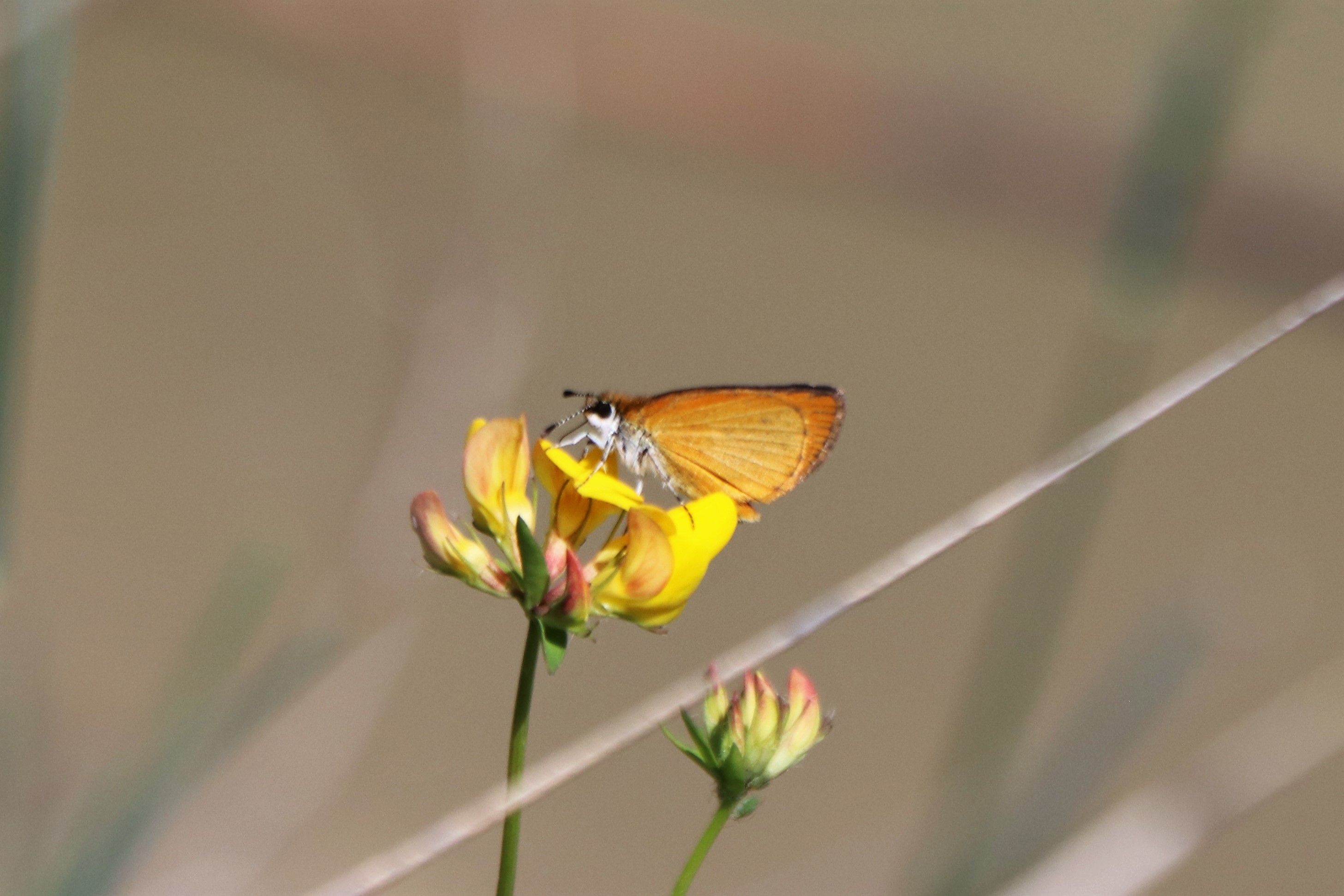
During the breaks between sessions, I spent my time searching for butterflies and dragonflies. The above Least Skipper, was my first of the year!

A pair of North Crescents were interacting, perhaps in the process of choosing a mate. There were many Crescents on the trails.

A Tiger Swallowtail had to compete with a number of flies to get minerals from some Great Blue Heron "poop". These minerals aren't found in the plant nectar that they drink.

Blue Dasher, female: This species is extremely wary and difficult to approach, hence the common name "dasher." Field Guide to The Dragonflies and Damselfies of Algonquin Provincial Park and surrounding area. Colin D. Jones, et. al. 

A female Clubtail! I was excited to find this individual but wasn't able to identify it to the species. I have learned they are a difficult group to identify and photos from many different angles are necessary for proper i.d. The most diagnostic characteristic of the "clubtails" is their widely separated eyes as can be seen in the photo. Field Guide to The Dragonflies and Damselfies of Algonquin Provincial Park and surrounding area. Colin D. Jones, et. al. 

Saturday, June 4, 2022

 A Fluttery Kind of Day!

Deryl found a freshly emerged Cecropia Moth on our street this morning. He convinced it to crawl onto a stick and carried it home. It seems to like our tree. Hopefully it will find a mate over night! The wingspan was greater than 6 inches!!

Close up view of the amazing colours on the body: If you look closely, you can see the feathery antennae. The moth spent some time pumping fluid into its wings and abdomen after being confined inside the cocoon all winter.

Like the Polyphemus Moth I found a few days ago, this adult Cecropia Moth will not eat. Its purpose at the adult stage is to mate and reproduce. If it hasn't become prey for another critter, it will likely die within 2 weeks. I'm not sure if this is the male or female.  Females produce natural chemicals called pheromones which can attract males from a mile away!
https://www.nwf.org/Educational-Resources/Wildlife-Guide/Invertebrates/Cecropia-Moth#:~:text=A%20female%20moth%20produces%20natural,they%20are%20black%20in%20color.

Common Ringlets flit slowly, with a bouncing flight, just above or down among the grasses, often landing on grass stems. (The Rom Field Guide to Butterflies of Ontario, Peter W. Hall, et al) I was very pleased to find one sitting still and nectaring on some Fleabane above the grasses!

There were several Peck's and Hobomok Skippers in the grasses at Canatara today. The top skipper is a Peck's. The lower butterfly is a Northern Crescent. I think they were having a territorial stand off!

Friday, June 3, 2022

June 3, 2022 Finds:

It must be Golden-backed Snipe Fly mating season in Canatara Park!  They can be found throughout eastern North America and are often observed resting on low vegetation in deciduous woodlands. Little is known about their life cycles or habits but the larvae of flies in the same family are known to develop in rotting wood or moist soil, feeding on small insects.
https://mlbs.virginia.edu/organism/chrysopilus_thoracicus

The striking pattern on the wings of this moth caught my attention this morning. A Tiger Moth became entangled in a web. When it was time for supper, the spider ate the juicy parts and left behind the wings and antennae! (The antennae are in the bottom left quadrant of the photo.)

I first spied this Cooper's Hawk while it was hunting on the ground. It flew up 6 feet into a tree then returned to the ground to continue the hunt.

I didn't want to disturb the hawk's hunting session, but I bet it was looking for chipmunks! Medium sized birds such as doves and starlings are common food for Cooper's Hawks but in Canatara, I often find them with chipmunks in their talons. This chipmunk with an extremely full cheek pouch was only 20 feet from the hawk.

It was nice to see a Great Blue Heron hunting in Canatara. They have been hard to find recently as they are busy feeding young at this time of year.