Friday, June 20, 2025

 Puffin Day!

It was a long drive to Elliston on the NW corner of the Avalon Peninsula, but it was definitely worth it! The site offers the closest view of Atlantic Puffins from land in North America. Hundreds of nesting pairs roost on a rocky outcrop. It only takes about 5 minutes from the parking area to walk to the best viewing point. As we headed toward the nesting grounds, a pair of Puffin Chairs welcomed us to the site!

Scenic views along the walk to the Puffins.

A sharply dressed black-and-white seabird with a huge, multi-coloured bill, the Atlantic Puffin is often called the "Clown of the Sea."
https://www.allaboutbirds.org/guide/Atlantic_Puffin/overview

They breed in burrows (visible in photo) in the North Atlantic, and winter at sea. Puffin chicks are called Pufflings. We didn't see signs of any hatched Pufflings.
https://www.allaboutbirds.org/guide/Atlantic_Puffin/overview

The Atlantic Puffin is the official bird of Labrador and Newfoundland!

Time to stretch the wings!

Checking out the scenery!

The best time of year to find Atlantic Puffins is in the spring breeding season when they come to shore to nest.
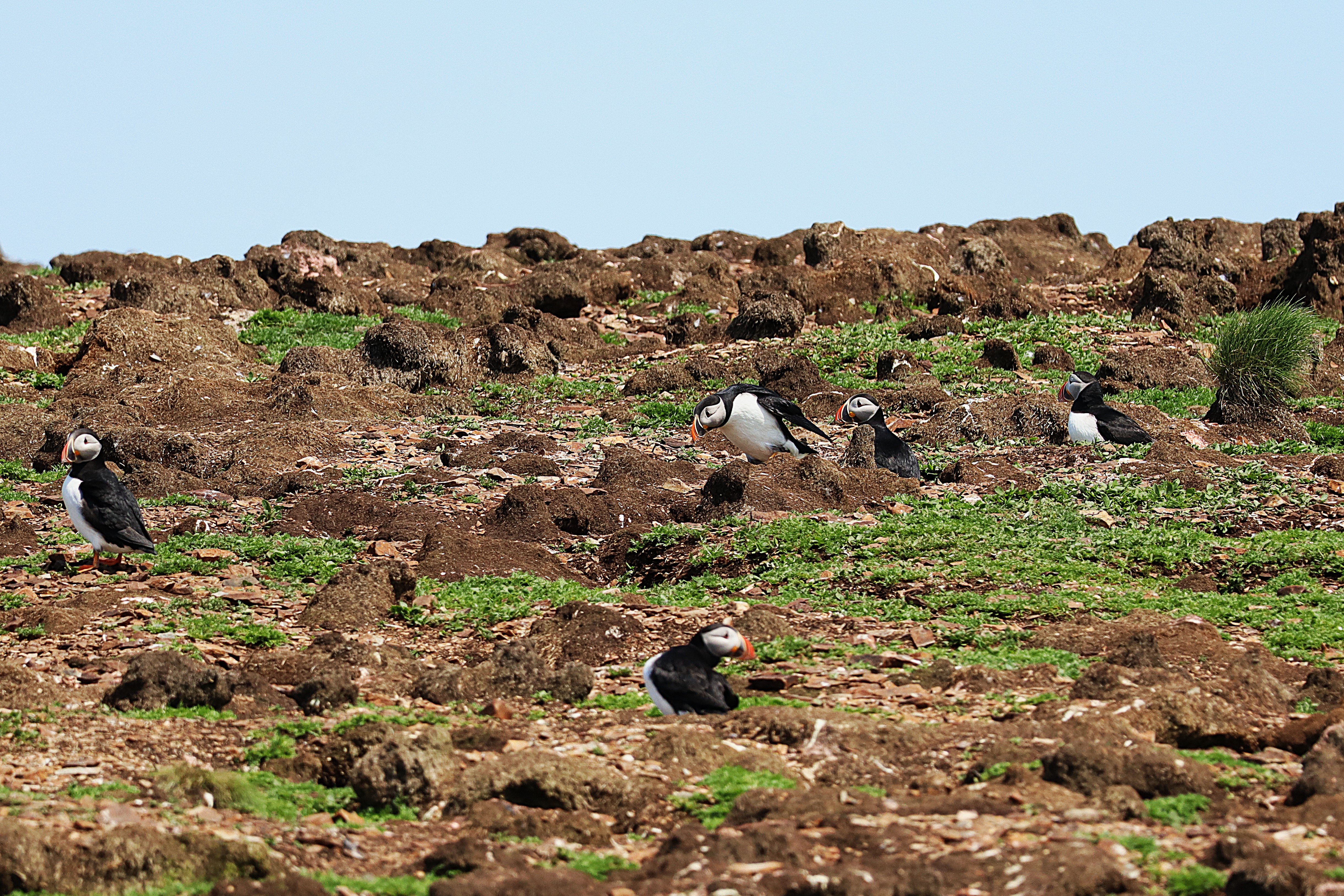
Atlantic Puffins dig a shallow hole or burrow into the ground with their bill and feet. Both sexes share the task, with the male typically doing more excavation than the female. On rocky islands, they make a nest under a boulder or within a crevice among the rocks. Pieces of grass and twigs often line the bottom of the burrow. Pairs tend to reuse the burrow year after year. Puffins lay one egg which is incubated for approximately 40 days.
https://www.allaboutbirds.org/guide/Atlantic_Puffin/lifehistory#nesting

Cleaning his feet after digging a burrow!

In flight, Atlantic Puffins flap their small wings frantically to stay aloft, but underwater, the wings become powerful flippers that allow the birds to catch small fish.
https://www.allaboutbirds.org/guide/Atlantic_Puffin/overview

Despite the windy, rugged conditions, butterflies floated around the edges of the cliffs and occasionally stopped for a nectar break. A Short-tailed Swallowtail kindly posed for a photo! (Black Swallowtails do not live in Newfoundland.)

Tuesday, June 17, 2025

 Newfoundland, Day 1: 

Cape St. Mary's Ecological Reserve!


We spent a week exploring the Avalon Peninsula in SE Newfoundland. The Ecological Reserve at Cape St. Mary's was one of our target locations to visit. We chose to travel in early June as it is Sea Bird nesting season. Several bird species spend most of their lives on the ocean, only coming to land during nesting season. One of the Sea Bird species we saw was the Northern Gannet.

The first sign welcomed us to bird rock where we were warned of dangerous, high cliffs. There are no fences or other barriers and visitors walk at their own risk.

Scenic views on the way to Bird Rock!

At nesting time, Northern Gannets form huge cliffside colonies. There are approximately 7,500 nesting pairs of Northern Gannets at Cape St. Mary's this year. Each white dot on the rock surface is a bird!
https://www.allaboutbirds.org/guide/Northern_Gannet/overview

As we got closer, we had better views of the birds!

A Northern Gannet delivers additional material to reinforce the nest.

Northern Gannets on the Nest .

Many Black-legged Kittiwakes also nest in the area. They are crow-sized gulls with grey on top and black legs and feet. I'm more familiar with juvenile birds that fly through our area most winters. They have a striking black 'M' pattern on their wings. The name comes from their cry of "kittiwake" when in flight. This species also spends most of its life on the open ocean.
https://www.allaboutbirds.org/guide/Black-legged_Kittiwake/overview

We only saw one Razorbill so I don't know if it had a mate. It is believed that the razorbill is currently the closest living relative of the now extinct Great Auk!
https://www.theanimalfacts.com/birds/razorbill/

Common Murres resting at the cliff's edge, very close to the trail.

Common Murre pairs are monogamous for several years. Pairs begin and maintain their bonds with a greeting ritual in which both birds spar with bills, bow, and preen one another.
https://www.allaboutbirds.org/guide/Common_Murre/lifehistory

Common Murres don't build a nest. Adults sometimes arrange small pebbles around the egg. The stones are cemented by guano, which perhaps helps the egg to stay on the cliff.
https://www.allaboutbirds.org/guide/Common_Murre/lifehistory

Always on the outlook for life of any kind, the Meander Ground Beetle caught my attention as it raced across the trail in front of us.

Day Emerald: a beautiful moth species native to Canada.

This Willow Ptarmigan was our 4th and final "life bird" of the day! It had been seen the day before, so we were watching carefully while walking the trails. It wasn't until we were driving away, that we spotted this one near the road. It stayed still for about a minute, likely because a Northern Harrier was hunting in the area and it didn't want to be the Harrier's next meal!

Sunday, June 15, 2025

 Enjoying Nature in Canatara!

The Coopers Hawk chicks have hatched! We believe there are 2 fuzzy young birds in the nest. One of the chicks, although looking sleepy, was moving around a bit in the nest.

3 American White Pelicans spent about 18 hours in Canatara Park recently. They typically nest in western Canada but a population is also based on an island in Lake Erie, off the tip of Point Pelee. The 3 Pelicans likely didn't breed and are doing a "tour" of SW Ontario!

I finally saw a Scarlett Tanager on June 2nd. Although not an adult male with the brilliant red and black plumage, this 1st year male will be sporting the fancy colours next year!

Mallard ducklings at rest. Mom was just out of the photo.

Members of the Large Crane Flies family - mating!

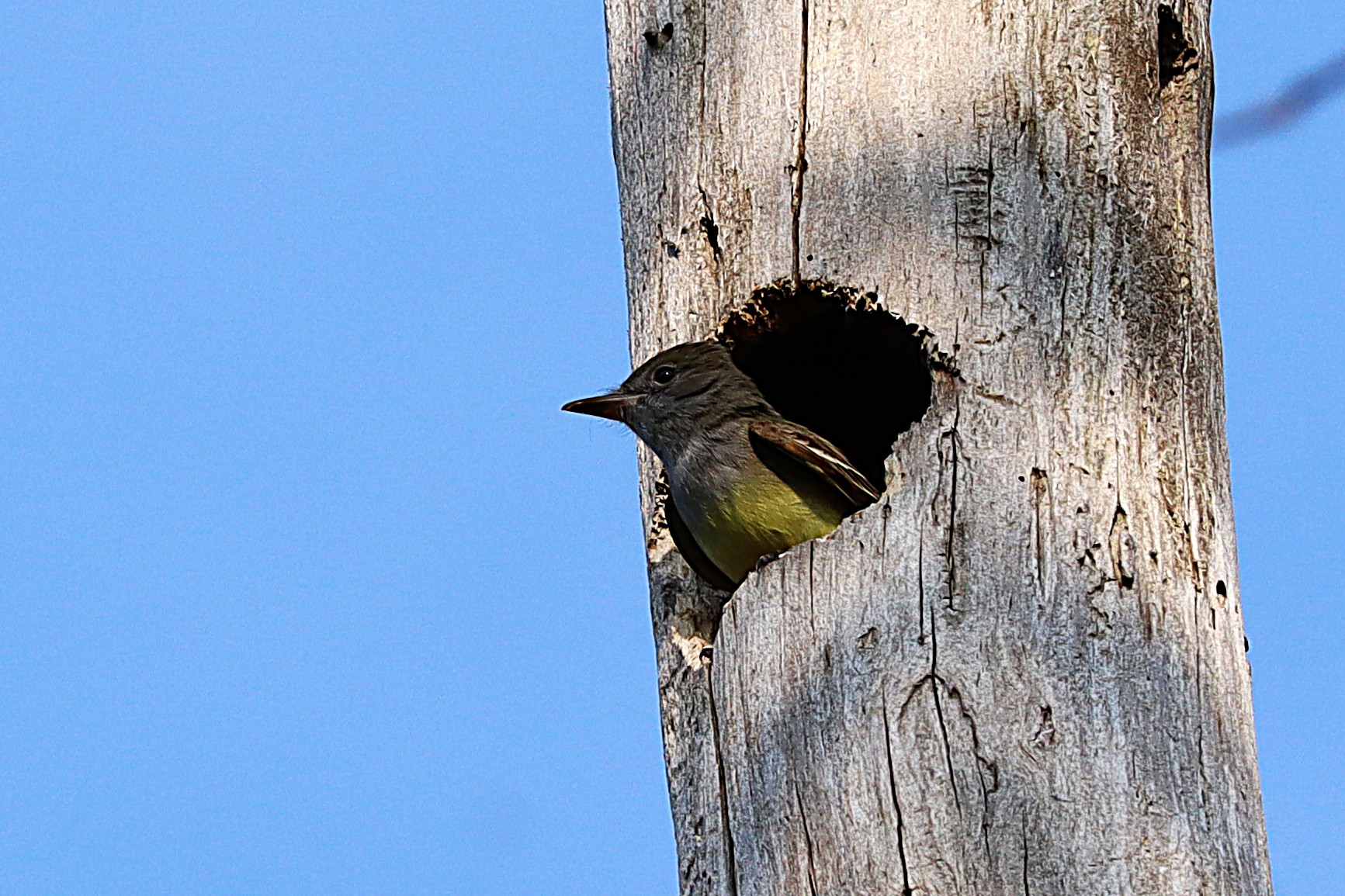
The Great Crested Flycatcher is a bird of the treetops. It spends very little time on the ground, and does not hop or walk. It prefers to fly from place to place on the ground, rather than walk. They share their habitat with other insect-snatching birds. However, they use an area higher in the canopy to avoid direct competition for food.
https://www.allaboutbirds.org/guide/Great_Crested_Flycatcher/overview

Great Crested Flycatchers are cavity nesters. We have recently watched them taking nesting material into an old woodpecker hole, high in a dead tree.

Many trips required to properly prepare the nest!

The ever beautiful (and uncommon) Common Checkered Skipper!

Morning sun in a blaze of orange, likely caused from the forest fires out west.