Sunday, May 9, 2021

 Spring Migration is Underway:

Spring Migration is slowly underway and birds are returning in full breeding colours. Baltimore Orioles have found our backyard feeder but are also busily hunting for insects in the tree tops. Look for Baltimore Orioles high in leafy deciduous trees. They are found in open woodland, forest edges, orchards, stands of trees along rivers in parks, and in backyards. (Cornell Lab, All About Birds)

Cape May Warblers hunt insects among branches, sip nectar from flowers, and eat fruit. They take most food by probing and picking. However, they also catch insects in midair or hover to pluck items from leaves and branches. (Cornell Lab, All About Birds)

Deryl took this photo of an acrobatic Black-and-white Warbler. Nests are usually built on the ground at the base of a tree, rock, stump, fallen log, or under a bush or shrub. (Cornell Lab, All About Birds)

Deryl's ears led him to a male Hooded Warbler in Canatara park. Few of us saw it, but many of us heard it. Individual male Hooded Warblers each sing a slightly different song. Their ability to recognize their neighbour may mean that they have to spend less time on territory defense. (Cornell Lab, All About Birds)

I was happy to see a Common Yellowthroat pop up in front of me this morning. This vocal bird sings one of my favourite warbler songs: "witchety-witchety-witchety"!  

Yesterday I watched a Northern Flicker doing home renovations! He spent a lot of time scooping up beak-fulls of sawdust and tossing the wood out of his tree cavity. Flying sawdust is visible in the picture.

Although I don't have a decent picture of a Worm-eating Warbler, Deryl found one for me in Canatara Park this morning! It was the first time I have ever seen the species which usually doesn't fly this far north. It was a great way to spend Mother's Day! Happy Mothers Day to all!


Friday, May 7, 2021

 Mallard Duck Tales:

During an evening walk in Canatara, Deryl noticed some tiny legs under a Mallard Hen. We had found our first ducklings of the season! Only the female incubates the eggs and takes care of the ducklings. (Cornell Lab, All About Birds)

Mom was very agitated with a nearby Mallard Drake. She left her 13 ducklings to defend her new family.
Mallard Drakes have been known to attack and kill ducklings that don't belong to them. The Hen obviously felt threatened by this Drake.

After a heated argument that lasted several minutes, 
she returned to her young family and counted her kids.

It was time to get everyone back to bed!

Good night little ones!

Thursday, May 6, 2021

 Goslings Everywhere!

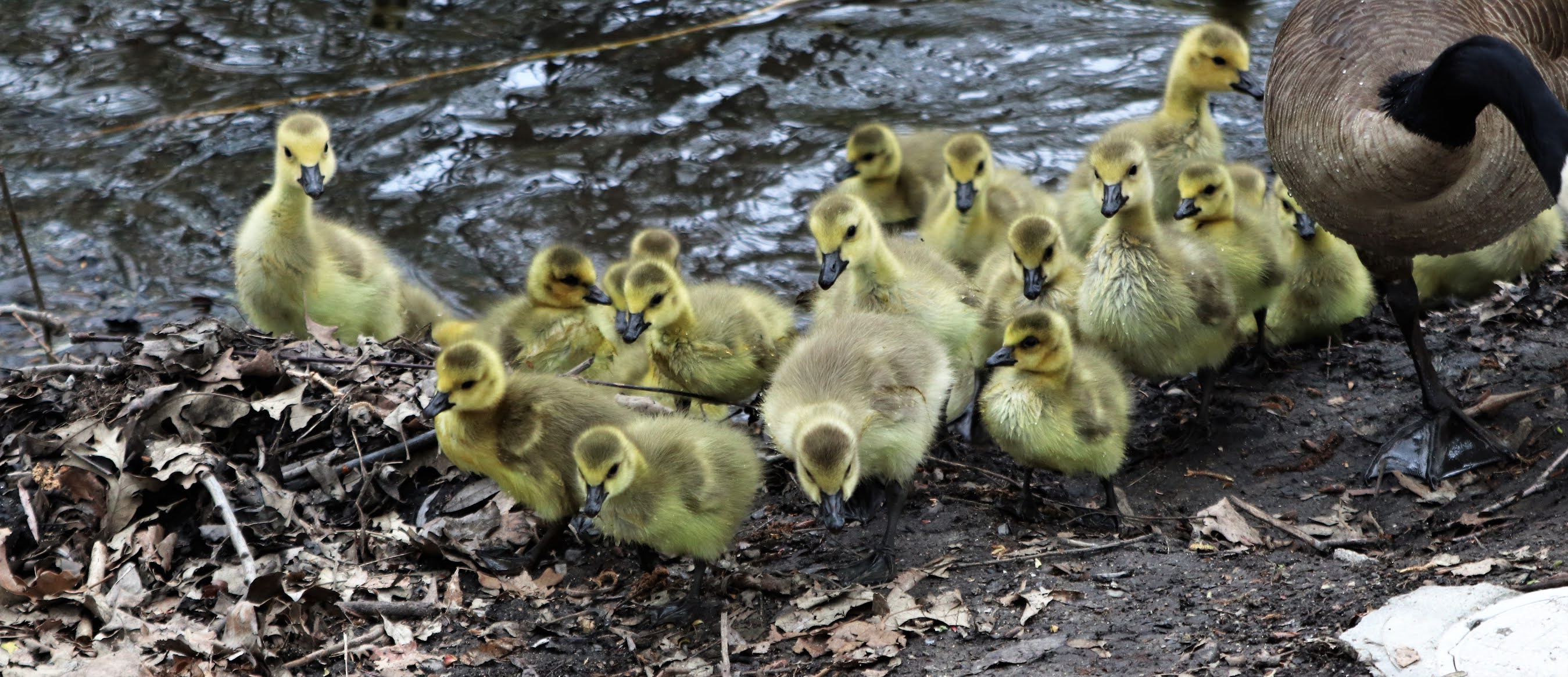
I can't seem to help myself; the Goslings are just too cute! It won't be long before they have grown past this phase. Recent cool mornings have kept the young geese tucked under Mom's warm feathers.


Sunday, May 2, 2021

 Groundhog Up a Tree!

We took a driving tour down river on Saturday and made a stop at Peers Wetland. Right beside the trail, something furry was looking down at us. We had no idea that Groundhogs could climb trees!

A quick internet search revealed that Groundhogs can in fact climb. It is believed Groundhogs will go up a tree to either escape predators, or survey their surroundings.

We wondered if this nearby, patrolling Mute Swan had anything to do with the Groundhog going up the tree. Mute Swans can be very defensive if anything gets too close to their nest. These aggressive birds often hold their wings half-raised in a display as they swim toward an intruder. Give plenty of space to nesting Mute Swans. They can be extremely aggressive and frequently attack canoeists, kayakers, and pedestrians who wander too close to a nest or chicks. (Cornell Lab, All About Birds) We did not see the nest, but this was one aggressive bird!

At an earlier stop, we witnessed a Mute Swan chase a Canada Goose. Mute Swans can weigh up to 32 pounds while Canada Geese on average reach 14 pounds.

On our drive home, we spotted a pair of Upland Sandpipers walking through some long grass in a pasture, hunting for food.

Goslings were lined up at the road within Canatara park waiting for their turn to cross.

When the crossing guards decided it was safe, across they went!


Friday, April 30, 2021

 A Colourful Start to Spring:

A pair of Wood Ducks swam in the Lake Chipican channel this morning. The male is one of our most colourful ducks. Look for Wood Ducks around the edges of swamps, sluggish streams, overgrown beaver ponds and wood-fringed marshes. They pick their way around vegetation growing out of the water or stand on tree branches or logs along the shoreline. (Cornell Lab, All About Birds)

Flocks of White-throated Sparrows are currently migrating through our area. Making a brush pile in your yard, will give these sparrows a place to take cover in between trips to your bird feeder. They have a pretty, wavering whistle which sounds like "Oh-sweet-canada". (Cornell Lab, All About Birds.)

Warblers are trickling into the area. I had the good fortune to see a Northern Waterthrush this afternoon! They forage near or on the ground or in shallow water where their long legs enable them to wade into pond edges in pursuit of prey. (Cornell Lab, All About Birds.)

A very rare Humming-pecker visited our back yard feeders this evening.

Couldn't resist showing a couple more goslings in the "too cute" category!

Wednesday, April 28, 2021

Goslings Are Abundant...

Is nap time over? 

Gander Goose calling his kids back.

A couple of cuties on the trail! Hatchlings are covered with yellowish down and their eyes are open. They leave the nest when 1-2 days old, depending on the weather, and can walk, swim, feed and even dive. They have enough energy remaining in their yolk sac to survive 2 days before feeding. (Cornell Lab, All About Birds.)

A Killdeer did his best to hide from me on the Canatara Beach.

Only last week, the same bird was sitting in snow. Brrr.

Virginia Bluebells! The "sky-blue" bells provide early spring 
nectar for butterflies and are members of the Forget-Me-Not family.


Saturday, April 24, 2021

 Hawk Migration!

Broad-winged Hawks were on the move this morning. While standing for 30 minutes on "Hawk Watch Hill" (a high point in Canatara, named by Deryl), we watched over 300 hawks migrate in kettles of up to 60 birds.

One of the flight "leaders" travelled closer to the ground for a photo op!

Warblers were also on on the move. I saw my first Palm Warbler of the season. The near constant tail-wagging of this species helps to confirm its identity. They mainly forage on open ground or in low vegetation, rather than in the forest canopy. (Cornell Lab, All About Birds.)

The Pine Warbler is the only warbler that eats large quantities of seeds, primarily those of pines. This seed-eating ability means Pine Warblers sometimes visit bird feeders. (Cornell Lab, All About Birds.)

The Brown-headed Cowbird is North America's most common "brood parasite".  (Males in top photo; a single female in bottom photo.) A female cowbird makes no nest of her own, but instead lays her eggs in the nests of other bird species, who then raise the young cowbirds. Cowbird eggs hatch faster than other species eggs, giving cowbird nestlings a head start in getting food from the parents. Young cowbirds also develop at a faster pace than their nest mates and they sometimes toss out eggs and young nestlings or smother them in the bottom of the nest. Most birds do not recognize Cow Bird eggs in their own nest. (Cornell Lab, All About Birds.) 

First of year goslings in Canatara Park with egg shell in foreground. They sure are cute at this stage! Luckily each pair of Canada Geese will only have one brood per year. It won't be long before we are over run with goose families!