Thursday, May 12, 2022

 Birds of Buttertubs Marsh: Nanaimo

Buttertubs Marsh has become one of our favourite wetlands to walk when visiting relatives on Vancouver Island. Spotted Towhees live in drier habitats than the Eastern Towhees. Some scientists have suggested that the bold white spots on Spotted Towhees' backs help them blend in to the sun-dappled undergrowth. (Cornell Lab, All About Birds)

The iridescent throat patch of male hummingbirds is called a gorget. The Anna's gorget extends over its head, making it more of a balaclava than a bib. Oddly, female Anna's Hummingbirds (above) have a tiny red gorget. Females of most species have none. (Cornell Lab, All About Birds)

Miners in the Yukon at the turn of the 20th century woefully referred to the Golden-crowned Sparrow as the "no gold here" bird, because its song resembled that depressing phrase. (Cornell Lab, All About Birds)

The MacGillivray's Warbler was a "life bird" for me. They breed primarily in mountainous regions of western North America, wintering from Mexico to Costa Rica. (ebird)

The Pacific-slope Flycatcher nests in shady mountain ravines, sometimes placing nests on banks or human-made structures, rather than in trees. (Cornell Lab, All About Birds)

These aerial insectivores perform acrobatic stunts over lakes and streams high in the sky in search of flying insects. Violet-green Swallows can look dark at first, but their true colours come to life when sunlight illuminates their metallic green backs and iridescent purple rumps. 
(Cornell Lab, All About Birds)

Tuesday, May 10, 2022

 Pipers Lagoon:

Pipers Lagoon is located within the city of Nanaimo B.C. It is built on an isthmus that extends out to a rocky headland. This 8 hectare park features twisting trails that lead to a number of seaside lookouts.

American Oystercatchers probe sandy and stony areas for clams, oysters and other mollusks, which they open by cutting or smashing the shell. (Cornel Lab, All About Birds)

Although we see Great Blue Herons in Ontario, they can also be found on the east and west coasts of Canada. This Heron found a yummy eel to eat for lunch. (The eel is wrapped around the beak). Along the Pacific coast, it's not unusual to see a Great Blue Heron poised atop a floating bed of kelp, waiting for a meal to swim by. (Cornel Lab, All About Birds)

The Savannah Sparrow is another example of a species found throughout Canada.

As we were about to leave Pipers Lagoon, Deryl noticed a fin in the water. While we watched, a pod of 10 Orcas swam past a distant island!!

Sunday, May 8, 2022

American Dippers!

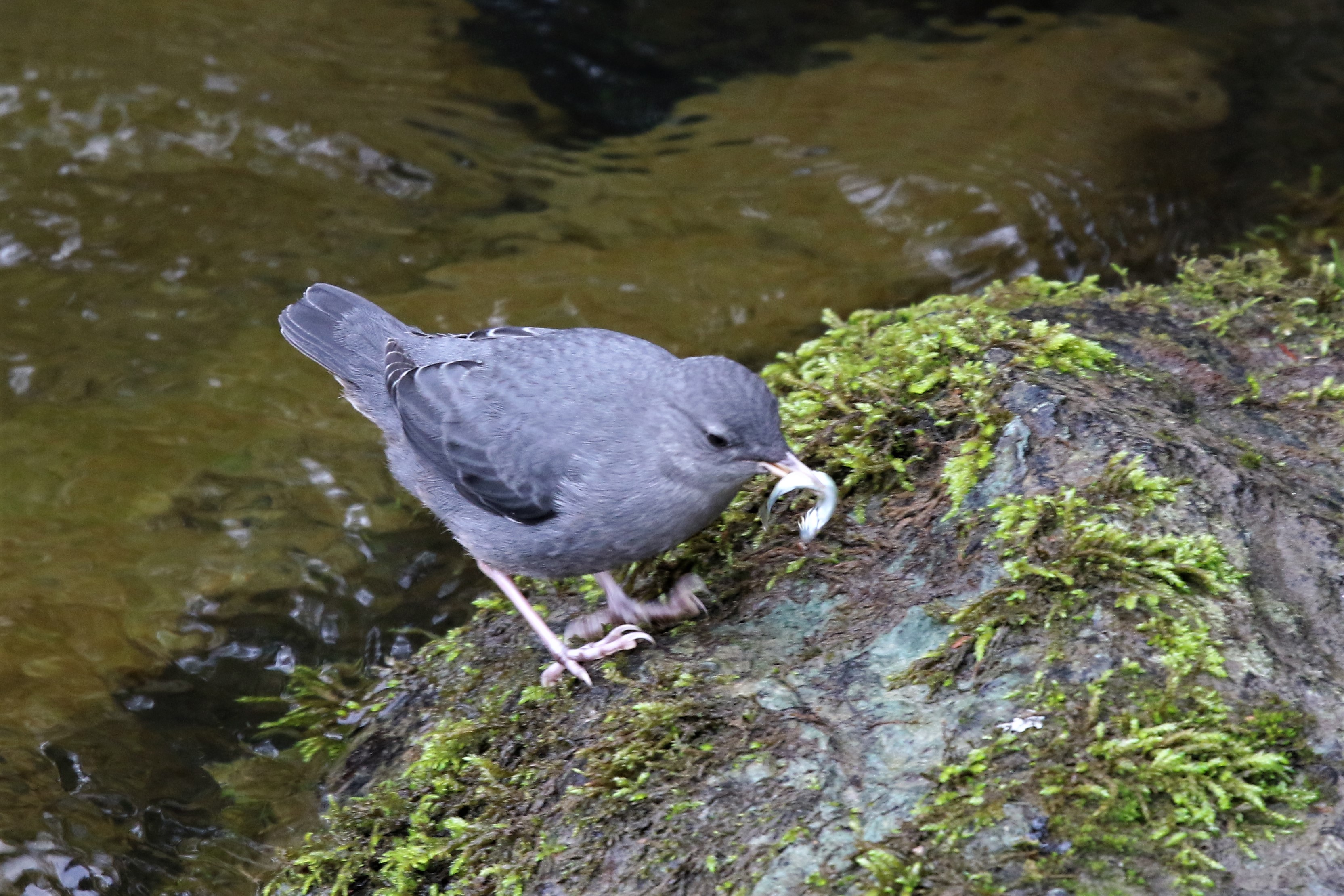
The American Dipper is North American's only truly aquatic songbird. We were happy to find 3 of them at a fish hatchery during a recent visit to Vancouver Island.

We watched one dip its head under water.

If it noticed potential food, it dove in. They can actually walk under water!! They flit among midstream rocks and logs, rhythmically bobbing the tail and disappearing for long moments. They use their wings to negotiate the current! (Cornell Lab, All About Birds)

 They sometimes emerged with a tiny fish (above) or crustacean! (Photo credit: Deryl)

Once the Dipper came to take a closer look at us as it ventured onto the grate over the spillway at the fish hatchery. These birds build mossy, domed nests on boulders, cliff ledges and bridges. We didn't see any sign of a nest. (Cornell Lab, All About Birds)
Saturday, May 7, 2022

 More Spring Things!

Blue-headed Vireos forage slowly from branch to branch, searching for insects. They tend to tilt their head to look carefully in all directions, then pounce on a caterpillar or other prey. Cornell Lab, All About Birds.

Everybody into the water! These goslings were resting on shore when a coyote ran past. Momma Goose was in full defense mode with lots of hissing!

Deryl found a Northern Waterthrush! They forage near or on the ground or in shallow water, where their long legs enable them to wade into pond edges in pursuit of prey. Cornell Lab, All About Birds.

Yellow Warblers breed in shrubby thickets and woods, particularly along watercourses and in wetlands. They often feed high in the trees but the cold weather has kept them down closer to ground level.

The Great Crested Flycatcher is a bird of the treetops. It spends very little time on the ground, and does not hop or walk. It prefers to fly from place to place on the ground, rather than walk. Cornell Lab, All About Birds.

Thursday, May 5, 2022

 More Returning Birds!

Its always exciting to see the return of migrating birds in the spring!

Gray Catbirds appear to be entirely slaty gray. With a closer look you'll see a small back cap, blackish tail, and a rich rufous-brown patch under the tail. Cornell Lab, All About Birds.

Deryl photographed a Caspian Tern patrolling the Lake Huron shoreline. Caspian Terns are the largest tern in the world and are easily recognized by the brilliant red bill and deep, raspy call. They are found all over the world, favouring both freshwater and saltwater environments.
Cornell Lab, All About Birds.

A pair of Blue-gray Gnatcatchers can build up to 7 nests in a breeding season! This can be essential to breeding success, since predation, nest parasitism, or mite infestations frequently cause nest loss and brood failure. Cornell Lab, All About Birds

Brown Thrashers are accomplished songsters that may sing more than 1,100 different song types and imitate other birds including Wood Thrushes and Northern Flickers. 
Cornell Lab, All About Birds

A squirrel that has obviously been fed by people, waiting for hand outs.

Two-headed, Red-bellied Woodpecker!!

Tuesday, May 3, 2022

 Spring in Canatara!

Despite the cold temperatures, nature is waking up! A Snapping Turtle lurks just beneath the surface. Snapping Turtles can live to be over 100 years old. They spend so much time underwater that algae grows on their shells. This can help them to blend in with their surroundings. https://www.ontario.ca/page/snapping-turtle

Mayapples

Purple Violets and Mayapples managed to survive the cold weather and snow last week.

Look closely at the photo and you will see a Northern Flicker and a European Starling. There was some intense interaction between the two birds. I'm happy to report that the Flicker was the victor! The Flicker grabbed the Starling by the leg with his beak and pulled the Starling from the cavity. Starlings were introduced to North America in the late 1800's by a group of Shakespeare enthusiasts who believed America should have all of the flora and fauna mentioned in Shakespeare's books. To survive in their new home, Starlings needed to adapt. They became aggressive and took over occupied nesting areas and food sources. Today they are the most abundant songbird in North America, but that came at the expense of many native birds whose populations declined. http://www.lakemetroparks.com/birding-blog/january-2021/european-starling-invasive-pest-or-misunderstood

It has been a few years since I last saw a Coyote in the area but one ran down the trail ahead of me recently. The coyote's senses of hearing and smell are so well developed that a sudden odour or noise can make it change its course in mid-step!  https://www.hww.ca/en/wildlife/mammals/coyote.html

Saturday, April 30, 2022

 Mandaumin Woods Nature Reserve!

This weekend, Lambton Wildlife is celebrating 50 years since the purchase of Mandaumin Woods Nature Reserve in 1972! The 25 acre property represents a typical Carolinian Forest in Lambton County. There is a short looping trail through the property. Some of the life we found on a visit in early April can be seen below:

Green Stink Bug
One-spotted Stink Bug
Unidentified Moth
Western Chorus Frog
Wood Frog