Monday, February 17, 2020

Family Day Weekend - 2020

Yesterday morning while touring through southern Lambton County, we watched a Northern Shrike dive from the hydro wire to a mouse he had caught earlier and wedged on a tree branch.
He dropped it a couple of times but continued to fly back to the bush to feed.

While making a detour to find a geocache, we found 6 Blue birds!  
This female was busy hunting for bugs in a pasture.

This morning's adventures started at Rock Glen Conservation Area which hosts the only waterfall in Lambton County (that I know of) on public property.  Birds were scarce as we hiked along the Ausable River but the scenery was beautiful.  I can't remember ever hiking at Rock Glen during the winter months.

After leaving the falls, we continued north, and just past Hungry Hollow, we found a pair of Ravens building a nest on a silo! Ravens have been added to our Lambton County Bird List for the past few years but this is the first sign of a pair nesting locally that we are aware of.

While watching the Ravens, we realized a couple of Horned Larks were feeding near the road edge.  We have been trying to get pictures of them this winter, but they usually fly away when the car stops.

Back yard birds, including this Carolina Wren continue to be fun to watch.  
We regularly see 2 wrens at the feeders!


Saturday, February 15, 2020

A Week of Snow and Ice and Cold

We ventured down to the St. Clair River first thing this morning 
and enjoyed the light reflecting on the water!
Many Long-tailed ducks were flying up and down the river.

Although the smooth areas at the mouth of river appeared to be water, 
they were fields of ice preventing the waterfowl from floating in the water for very long.  
We saw no sign of the Harlequins this morning.

Some ice was breaking up before heading into the river.

Sitting on an icy bench could potential result in a slide into the frozen water.


Ice forming on the railing shows the incredible power of the wind and the water!

After heading inland, we found a slightly cooperative Kestrel for a photo in flight.

Earlier in the week I found some hungry birds during my lunch break.

A pair of Golden-crowned Kinglets were foraging for bugs.

A Dark-eyed Junco fluffed his feathers in the sun, trying to keep warm!

There were tons of rabbit, squirrel and bird tracks in the snow.  Due to last springs long-lasting mud, more board walks were placed on our trails creating shelter for bunnies!

Ice crystals in a puddle at Henderson Conservation Area.

Sunday, February 9, 2020

A Busy Week

It was a very busy week and I didn't have much time outside with my camera. 

The incredibly warm weather early in the week, was fooling some House Sparrows into collecting nesting material in February!  I hope they didn't get around to laying eggs!

4 Harlequins, (Ducks, not romance novels) have been hanging out in the St. Clair River this weekend.  As noted in Hinterland Who's Who, "It gets its English name from characters in Italian comedy that wear masks and have oddly painted costumes. They are a shy sea duck, about half the weight of a mallard." Deryl got a great photo of them yesterday!


When I had a chance to check them out today, they ended up taking flight.  The birds were much closer than the ones we saw on Vancouver Island last spring.

While joking about the Harlequin Ducks, I realized that Valentine's Day is this week and thought a beautiful red Cardinal would be a good way to sign off! Have a nice week!

Sunday, February 2, 2020

Weekend Birds

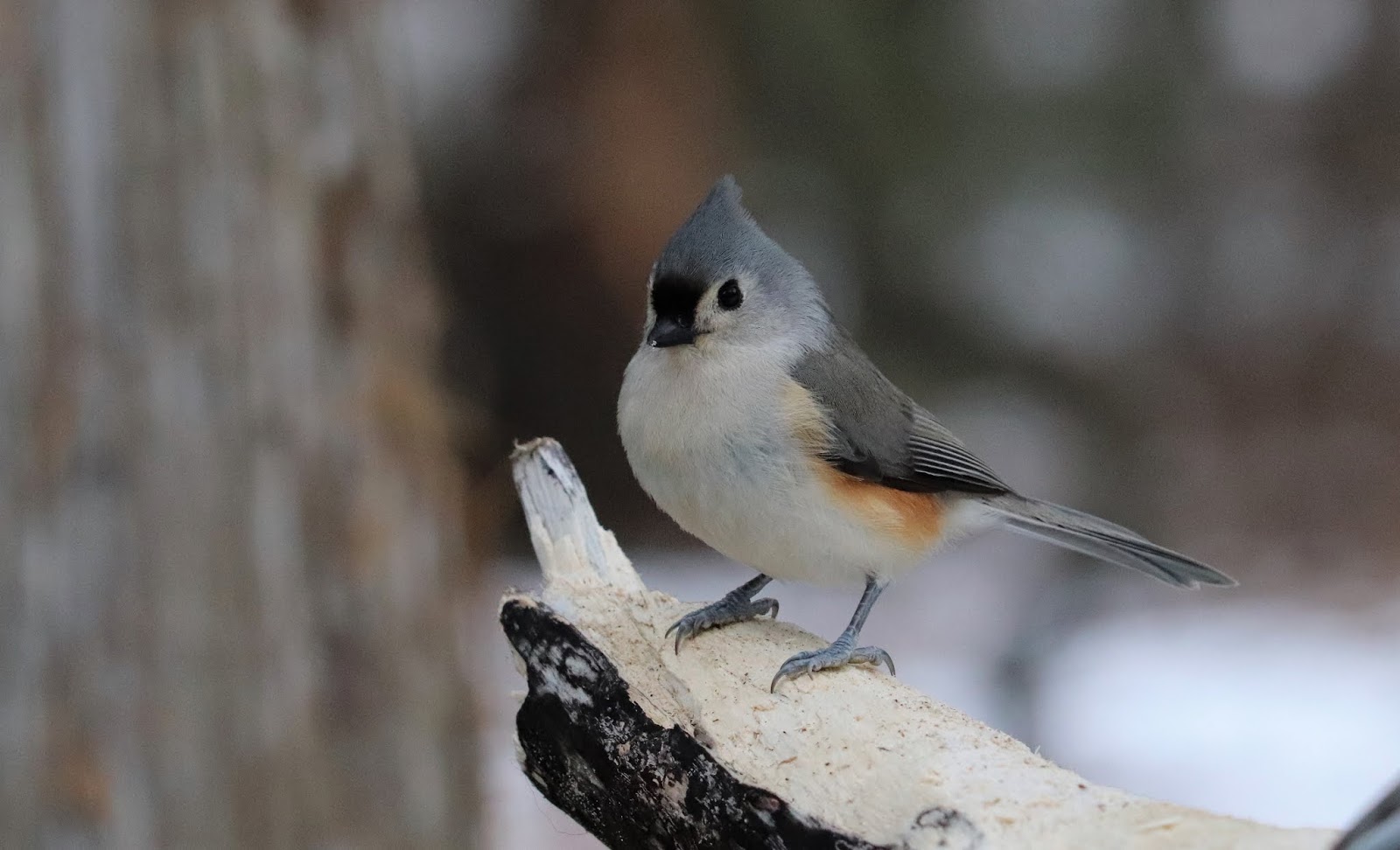
The Tufted Titmice at the Pinery were interested in our food, but not in hand feeding. 

I had never thought about the difference between male and female White-breasted Nuthatches before.  This picture shows the closest bird, a female, with a grey head. The male on the other hand has a dark head.  I learn something new every day!

The Chickadees squabbled amoungst themselves and the other species when waiting impatiently for their turn at the seed.


We headed to South-east Lambton County today in hopes of finding a Golden Eagle.  Mosside Line was beautiful with the fresh snowfall.

We stopped to check out the many Mourning Doves perched on stalks of corn.

When they made a quick departure, we noticed the reason for their distress; the Golden Eagle was near!

Just ahead we spotted a Northern Harrier take off from a road side tree.

We then headed west along Bentpath Line to the St. Clair River where we found lots of ducks at Sombra, including this Redhead who was resting on the shore.


An American Wigeon, a first of the year for us, was a highlight. We also managed to find a pair of White-winged Scoters in the river and many duck and gull species.

Friday, January 31, 2020

Black-capped Chickadees

I often mumble to myself about all of the Chickadee photos that I take, but I can't help myself as they are so cute.  I was recently asked by Lambton Wildlife to do a species presentation on any vertebrate of my choosing. While scrolling through my photo files, I realized that I now had a use for all those Chickadee pictures!

"Did I just get a tweet?" It is a joy to watch their curious nature!


During the winter months, chickadees eat enough food daily to equal their body weight, and spend almost all of their waking hours looking for food.

One Chickadee weighs 11-12 grams, the equivalent of 5 pennies!

Chickadees develop a pecking order around food, and younger birds need to wait for their elders to eat first.

Black-capped Chickadees are able to increase the size of their brains by 30% in the winter, allowing them to remember a thousand hiding spots for their cached seeds.  I have watched many a seed be tucked into tree bark by this species.  Brain size returns to normal in the spring when they no longer need the extra memory space.

Nests are excavated by both adults in decaying stumps.  The nest is about 21 cm deep.  Bark and moss is often used for the foundation and animal fur, feathers, or man made materials are used as a lining.

The number of eggs can range from 1 to over 10. Incubation lasts 12-13 days and the hatched chicks stay in the nest for another 12-16 days before venturing out into the world.

The oldest known banded bird lived to be 12 years, 5 months.  
The average age of a wild bird is 2.5 years.

Insects make up 70% of their food. Chickadees provide an excellent form of natural pest control eating insect eggs and larva. They apparently have a particular fondness for ants.


Adult Males can be identified as they have a larger black bib than the female.  In my experience, Chickadees are so active, that I have not learned to recognize the difference in bib size.

If you ever have the chance to hand feed chickadees, I highly recommend it!  
Experiencing "that chickadee feeling" provides an excellent opportunity to connect with nature!!

Dream big, little one!!