Friday, April 14, 2023

 A Visit to Petrolia

The unusually warm weather this week resulted in a lot of spring growth. I was happy to see my first Spring Beauty of the year! The pink veins and yellow circle on the flower petals act as nectar guides for pollinators. Because those pollinators are generally out and about when the sun is shining, spring beauty only opens on sunny days. Some Native Elders used this plant behavior as a barometer to predict oncoming storms.
https://www.ediblewildfood.com/spring-beauty.aspx

Harbinger of Spring is still blooming. It is one of the earliest blooming, native spring flowers.
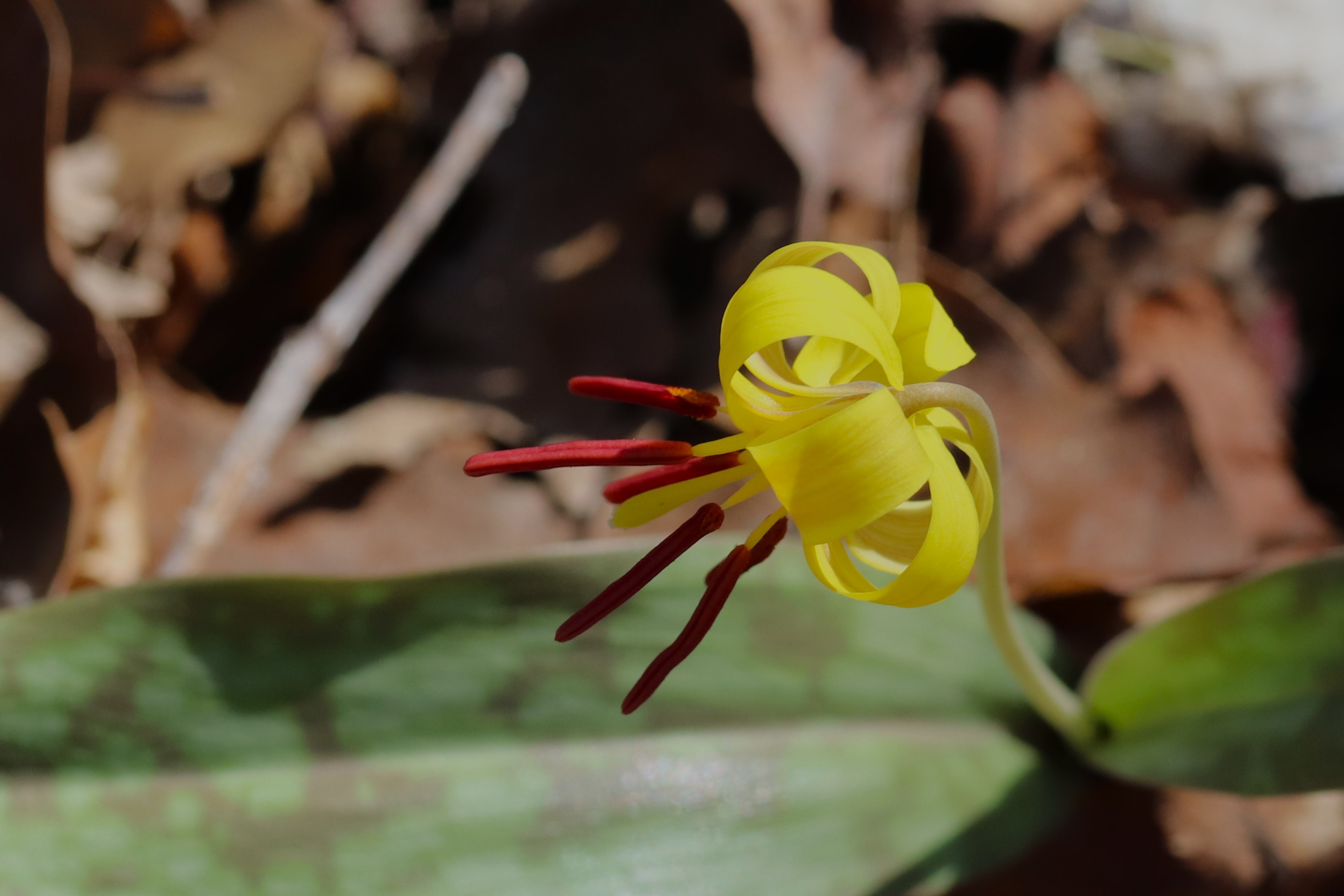
Trout Lily's are most likely to be found in the understory of a deciduous forest.

Two Tree Swallows at a nest box: They feed on small, aerial insects that they catch in their mouths during acrobatic flight. Tree Swallows get their name from their habit of nesting in tree cavities, but they will also use man-made nesting boxes.
https://www.allaboutbirds.org/guide/Tree_Swallow/overview

Green Frogs can be found in shallow, permanent waterbodies such as swamps, ponds, and lakes. They often bask along shorelines in the summer. If you walk towards the edge of a wet area, you may hear the plop, plop sound of frogs jumping into the water for safety.
https://ontarionature.org/programs/community-science/reptile-amphibian-atlas/green-frog/
The Snapping Turtle is Canada's largest freshwater turtle. They spend so much time underwater that algae can grow on the shell which helps them blend in with their surroundings. The turtles head is in the centre of the above photo.
https://www.ontario.ca/page/snapping-turtle

Wednesday, April 12, 2023

 Spring in Canatara

The forest floor is beginning to bloom with Wildflowers. Bloodroot is one of the earliest Spring ephemerals. Ephemerals are around for a short period of time when the ground is moist and before the leaves open fully on the trees.

Male Downy Woodpeckers are having territorial battles for nesting locations.

A Golden-crowned Kinglet admires his reflection in the water.

A noisy Mallard Hen thinks she's a Wood Duck and sits high in a tree.

Red-breasted Nuthatch posing for the camera!

Tree Swallow eyeing up a nearby nesting box.

Eastern Comma warming up in the sun!

Sunday, April 9, 2023

 Deer Rescue on Lake Superior!


On Saturday morning, my brother's morning paddle turned into a White-tailed Deer rescue! Dave lives on the north shore of Lake Superior, west of Thunder Bay.

Fresh ice formed the night before when temperatures dipped to -12 Celsius. When Dave first spotted the ice flow, the deer was 1 kilometre from shore. (Isle Royal is the dark land form in the distance.) The noise of Dave's approaching canoe gliding through thin ice caused the deer to jump into the water. It then started swimming for shore.  Dave wasn't hopeful that it would be able to swim the entire distance.

Incredibly, it reached shore but was exhausted, cold, and could go no further.

Dave initially moved the deer out of the water, but it was never going to climb up the ice shelf.

The deer allowed Dave to pick him up and move him to a better place on the beach. Since the sun was warming things up nicely, Dave left him alone and hoped for the best. 
🌞🌞🌞
This morning when he paddled back to the site of the beach rescue, the deer was gone. Since there was no sign of a struggle with a predator, he believes the deer recovered! I'm very proud of you, Dave! Right place, Right time, Right person!

Saturday, April 8, 2023

North Lambton, April 7th:

It was a cool day, but the sun was shining, and I saw my first butterfly of 2023. - a Mourning Cloak. This individual spent the winter as an adult, probably tucked into loose bark under fallen logs.
Blue-spotted Salamanders spend their lives on the forest floor, often living underground in burrows. They breed in permanent swamps or temporary ponds, marshes and sometimes roadside ditches. They will overwinter underground in the forest.
https://ontarionature.org/programs/community-science/reptile-amphibian-atlas/blue-spotted-salamander/

The Eastern Red-back Salamander is most commonly found in deciduous or mixed forests. The species is restricted to mature woodlands with lots of fallen logs, coarse woody debris and leaf litter.
https://ontarionature.org/programs/community-science/reptile-amphibian-atlas/eastern-red-backed-salamander/ 

Eastern Red-backed Salamander - leadback phase

A few pairs of Sandhill Cranes may be nesting in the Port Franks area this year!

White Birch trees looked pretty against the blue sky.

Thursday, April 6, 2023

 American Bittern in Sarnia!

We were fortunate to view an American Bittern in Canatara recently. It is smaller than a Great Blue Heron, but larger than a Green Heron.

The streaky, brown and buff heron can materialize among the reeds and disappear just as quickly. We watched it "appear and disappear" as it meandered through a wooded area. The eyes can focus downward, giving the bird's face a comically startled, cross-eyed appearance. This visual orientation presumably enhances the bird's ability to spot and capture prey. The eyes turn orange during breeding season.
https://www.allaboutbirds.org/guide/American_Bittern/overview

These stealthy carnivores stand motionless amid tall marsh vegetation, or patiently stalk fish, frogs, and insects.  It was viewed capturing earthworms yesterday.
https://www.allaboutbirds.org/guide/American_Bittern/overview

I hope the stop in Canatara provided the food and rest it required to continue its migration journey!

Tuesday, April 4, 2023

 Down By the Sarnia Bay:

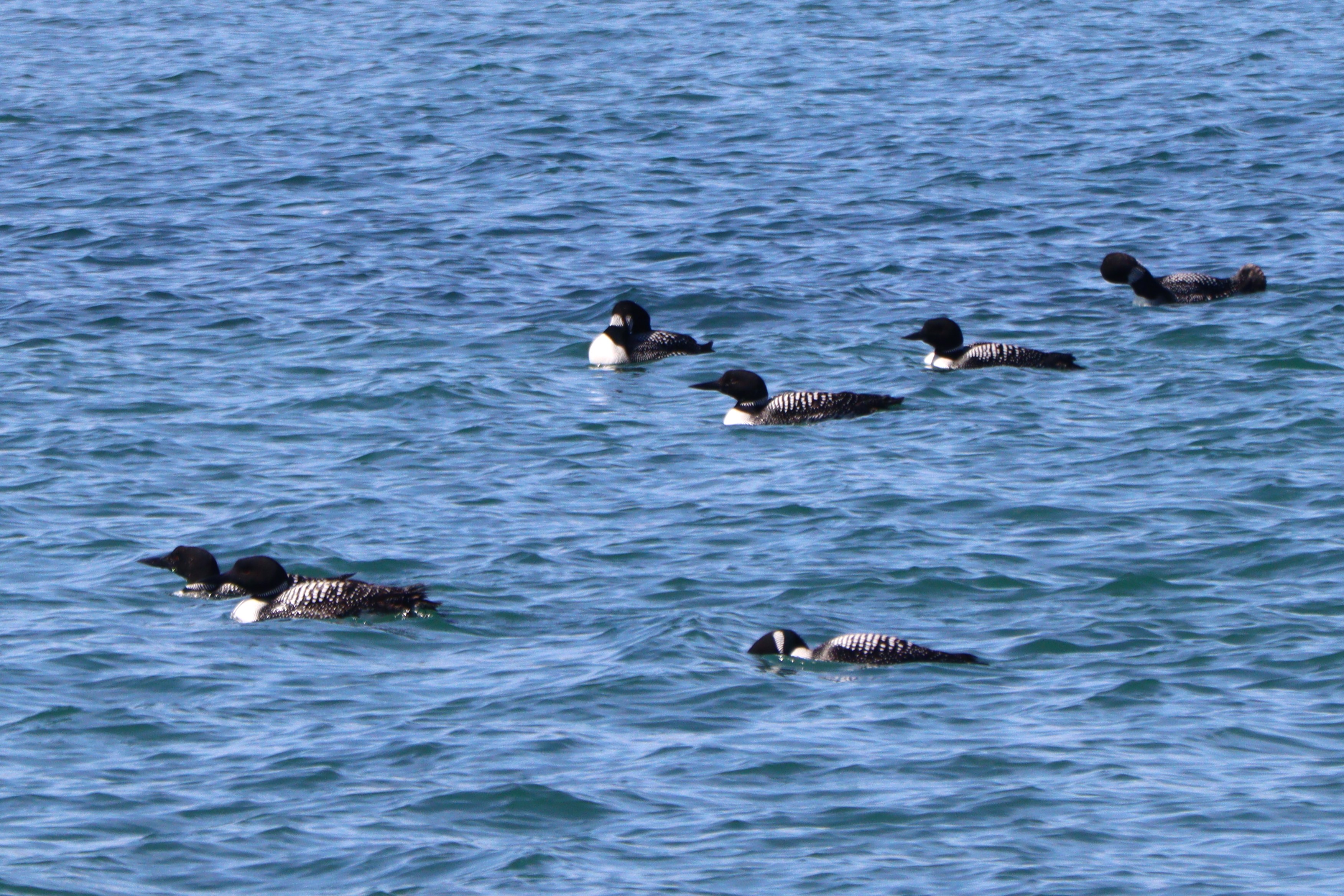
Common Loon

As many as 26 Common Loons have been spotted at the Sarnia Bay in the past week. The birds are using the bay as a migration stop to rest and refuel their bodies before heading to their breeding grounds. I was able to capture 7 individuals in this photo.

Of all the diving ducks, Long-tailed Ducks log the most time underwater. During foraging excursions, they spend 3 or 4 times as long underwater as on the surface.
https://www.allaboutbirds.org/guide/Long-tailed_Duck/overview

Some waterfowl will be staying in the area to nest. A pair of Mallards have begun the mating ritual. The hen spent more time underwater than on the surface thanks to the aggressive behaviour of the Drake.

A boldly marked Song Sparrow hunts for insects at the edge of the water.

Sunday, April 2, 2023

 Treasure Trove of Birds!

I often think of Bird watching as a treasure hunt that I don't have to set up! Spring Migration is an ideal time to find returning birds!

It was exciting to find my first Warbler of the year - a Yellow-rumped Warbler on April Fools Day! 
Yellow-bellied Sapsuckers have also returned to Canatara Park! They are the only completely migratory woodpeckers in Eastern North America. The sap wells made by these birds attract butterflies and hummingbirds which also feed off the sap flowing from the tree. In some parts of Canada, Ruby-throated Hummingbirds rely so much on sap wells that they time their spring migration with the arrival of sapsuckers!
https://www.allaboutbirds.org/guide/Yellow-bellied_Sapsucker/overview

Brown Creepers can be found spiraling up trunks and main branches as they look for food by probing into crevices and picking at loose bark with their slender, downcurved bills. They burn an estimated 4-10 calories per day. By eating a single spider, a Creeper gains enough energy to climb nearly 200 feet vertically!
https://www.allaboutbirds.org/guide/Brown_Creeper/overview


Fox Sparrows tend to feed on the ground close to dense vegetation. They enjoy small seeds and many kinds of berries. 
Fox Sparrows will scratch for fallen seeds underneath bird feeders. Encouraging shrubs or berry bushes to grow at the edges of your yard, or keeping a brush pile, are good ways to provide places for Fox Sparrows to forage. (Video was taking through a glass window in our backyard.)
https://www.allaboutbirds.org/guide/Fox_Sparrow/overview

In recent years, Canada Geese have nested on roof tops in Canatara Park. With the construction of the building that houses the "Canatara Choo Choo", the geese have a new spot to check for nesting opportunities away from many predators.