Wednesday, March 9, 2022

 Recent Finds!

Thanks to Deryl deciding to go for a bike ride BEFORE work, several of us had a chance to see a Ross's Goose that he found at Blackwell Trails pond. The bird had unfortunately left before I could get there, but luckily it was re-found elsewhere by Allanah! I did not get to see this species last year. It is a small goose, larger than a Mallard with a triangular bill. It has a shorter neck than a snow goose. (BTW, Deryl was only 3 minutes late for work!)

As soon as I heard that the goose had flown, I drove to the Suncor Trail. No luck with the Ross's Goose, but I was happy to see a beautiful male Northern Pintail! When in water, they dabble on the surface filtering out seeds and insects with their bills. (The Cornell Lab, All About Birds.)

A Northern Mockingbird was found feasting on Sumac in the same location as last year. Perhaps it will stay and nest. This is an uncommon bird for Lambton County.

A tiny Bufflehead stayed reasonably close to shore in the St. Clair River, allowing Deryl to snap a photo. When nesting time arrives, this species mostly commonly uses old Northern Flicker cavities to raise their young. (The Cornell Lab, All About Birds.)

I had a close encounter with a pair of Canada Geese along a trail in Canatara Park this morning. Nesting time is fast approaching!

Ice formations such as this one along the Lake Huron Shoreline are diminishing in size. Spring is getting closer!!

Sunday, March 6, 2022

 More Signs of Spring!

I saw my first flock of Tundra Swans this spring heading in a north-westerly direction over Wawanosh Wetlands. Since they were out of formation, they may have been considering stopping but changed their minds upon seeing the frozen water. I understand that only a few swans have arrived at the fields in North Lambton. Melt water and left over grains in a former lake provide an annual resting stop for the swans in their migration to the Arctic.

A "First of Year" Common Grackle visited our backyard feeder then sat in the sun on an overhead wire, giving me a devious stare!

The last time I saw wildlife peeking out of this hole, an Eastern Screech Owl was staring back at me. The owl must have moved on as a Chipmunk has moved in!

In my rush to reach a high point of land for the morning sunrise, I stumbled upon a Red-tailed Hawk who also seemed surprised to see me. I had time for 2 pictures before he flew away.

I was happy to see a bat box erected in the Canatara Meadow (showing an outline of a bat so people will know what it is). Loss of tree cavities makes it hard for bats to find nesting spots and bat boxes can provide suitable substitute nesting areas. It is generally too cold for them to survive through the winter in the boxes. Bats in Ontario are insect eaters which make them good neighbours in the spring and summer!  (https://www.nwf.org/garden-for-wildlife/cover/build-a-bat-house) We even saw a couple of bats last night while we unsuccessfully watched for American Woodcock!

Tuesday, March 1, 2022

 An "Inside" Thing With Wings!

I found an adult Grapevine Epimenis Moth fluttering in the basement after "day dreaming" about spring on my morning walk. It is only 2 cm wide and is uncommon in Ontario. No idea how it got inside. They emerge from March to May and since we have grapevine growing on one side of the house, I'll be watching for its siblings!

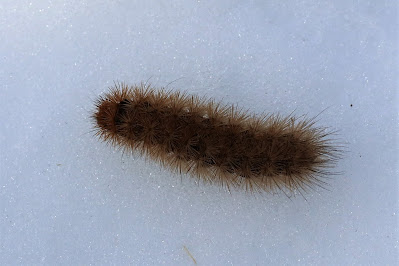
A caterpillar that probably wished he was inside is this Ruby Tiger Moth. I watched it crawl across a snowy trail at Wawanosh Wetlands yesterday.

A Black-capped Chickadee vigorously attacked some Burdock Seed heads at Wawanosh Wetlands. Burdock seeds can be very difficult to remove from clothing and hair. The little Chickadee was likely hoping to find the larva of the Burdock Seedhead Moth which overwinters in the seed head of Burdock. The larva will pupate in the spring and emerge as an adult moth.

Canada Geese have been gathering in large numbers as spring approaches.

17 Northern Pintails were found at Suncor Trail last week. I was happy to find 3 of them! When it comes to breeding, this species starts nesting as soon the ice begins to thaw, arriving by late April in places as far north as the Northwest Territories! (The Cornell Lab, All About Birds)

A lone male Long-tailed Duck swam close to the edge of the St Clair River as I walked along the path. He popped up several times giving me a few opportunities to take his picture! These birds can feed as deep as 200 feet, swimming with their wings, catching invertebrates and small fish! (The Cornell Lab, All About Birds.)

Sunday, February 27, 2022

 Deryl's "Green" Bird Year!

During 2022, Deryl is attempting a "Green Big Year". Any birds on his Lambton County list will be obtained without the use of fossil fuel powered transportation. He will travel by self-powered transportation throughout the City of Sarnia and possibly beyond. Weather conditions even permitted a birding trip via Cross-country Skis in February!


We are grateful to live so close to Canatara Park, a 300+ acre park consisting of forest, meadow, a small lake, and Lake Huron shoreline. The different habitats allow for a large diversity of bird life, all of which are within walking distance! One of his first birds of the New Year was a Hermit Thrush. A pair of thrushes made the choice to stay in Canatara this winter.

On January 16, during a lull from snowstorms, Deryl rode his bike to the Suncor Trail and found a Wood Duck, among other species.

Wood Duck

Since January 1, 2022, he has walked 117.2 kilometres, snowshoed 4 km, and cross-country skied 5 km. Bike riding has earned him another 62 km of exercise! Total: 188.2 kilometres!

Some of the winter species that he has found include a Northern Saw-whet Owl...

Snow Goose, blue-phase

Harlequin Duck

Gadwall

Common Redpoll

He is enjoying tackling the green year, but is becoming impatient with the winter weather, even though I remind him we do live in Canada! He has found an impressive 79 species since January 1st! Some species are currently in Lambton County but are just out of reach. He, along with many others, are eagerly awaiting the arrival of spring!!

Wednesday, February 23, 2022

 Spring is in the Air!

American Robins are often associated with the arrival of spring.

I have seen small groups of robins off and on through the winter but this morning I saw 25 in Canatara Park! They are gathering in larger groups as they hunt for food which is becoming harder to find.

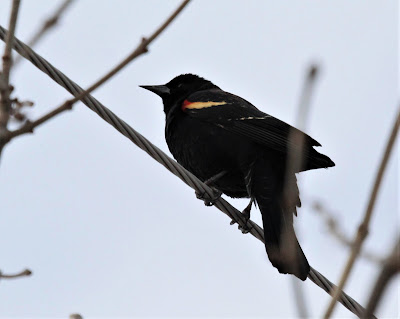
Since some Robins are known to stay through the winter, my personal "first sign of spring" is the arrival of Red-winged Blackbirds. Deryl photographed the above male bird at Wawanosh Wetlands on February 21st!

Pussy Willows are starting to emerge! Pussy willows are flowers protected by a soft coating of hairs, before they start to fully bloom. This plant was photographed on February 21st. in Canatara Park. Spring is getting closer!!

                                American Beech Bud                    Pawpaw Bud
                                          Walnut Bud                              
Buds are sometimes thought to be a sign of spring. Tree buds actually form in late summer to protect tiny leaves through the winter; much like mitts protect our hands during the cold months. Buds are more noticeable in late winter/early spring when the weather warms up and the leaf inside starts to grow, causing the bud to swell.  All of the bud pictures above were taken in late September. Next fall on a walk through the forest or even in your own yard, take the time to look for buds. You will find many colours and shapes of buds protecting next summer's leaves!

Another sure sign of spring is the territorial battles that have begun on frozen Lake Chipican. Canada Geese are becoming vocal as the better weather approaches!

Sunday, February 20, 2022

 American Crow:

American Crows are common birds of fields, open woodlands and forests. They thrive around people and can be found in agricultural fields, lawns, parking lots, athletic fields, roadsides, towns and city garbage dumps. (The Cornel Lab, All About Birds)

I'm not sure if its courtship time for crows, but the one on the left continually offered snow to the bird on the right. She really didn't appear interested at all.

Young American Crows do not breed until they are at least 2 years old. Most do not breed before 4 years of age. In many populations, the young help their parents raise younger siblings for a few years. Families may include up to 15 individuals and contain young from 5 different years! (The Cornel Lab, All About Birds)

Crash Landing in behind! It wasn't very graceful!

Red-tailed Hawks don't get any peace when discovered by crows.

Fort Gratiot, Michigan Lighthouse framed by ice after storm.


Thursday, February 17, 2022

 Winter Continues:

During winter weather, birds have a variety of ways to stay warm.  Some methods include relying upon the insulative qualities of their feathers, fatty reserves from fall feeding, and absorbing sunshine on sunny days. Small birds will sometimes roost in large groups to share body heat. Staying through the winter months helps them to maintain territorial areas and also avoid the hazards of migration!

Northern Cardinal, female searching for seeds.

White-breasted Nuthatch pausing from her insect search.
(Females have a blue-grey crown, while males have a black crown.)

I recently found 11 eggs on a Teasel stem. After a bit of research, I learned they are Katydid eggs!

A well-camouflaged Katydid. (June 2020)

Deryl watched a vole hunting for seeds above the crusty snow. The colour contrast between the vole and snow makes this fellow an easy target for a predator's meal!

If I don't see the turkeys, I often find their tracks in the snow.

Lake Huron continues to look ominous!