Friday, November 10, 2023

 Fungus Among Us!

Wet weather created good growing conditions for fungus and mushrooms this year. The Green Wood Cup was possibly my favourite find because of the unique colour.

Participating in a Lambton Wildlife Fungus walk in mid-October allowed us to find species which included Birch Polypore.

Crowded Parchment, was definitely "crowded" on a rotting log.

Witches Butter was a well named species. It is also called Orange Jelly Spot.

False Turkey Tail

Wolf's Milk is a kind of amoeba which is often mistaken for fungus. It can ooze a pink "paste" if the outer wall is broken before maturity. When mature, the colour tends to become more brownish.
https://www.inaturalist.org/taxa/47680-Lycogala-epidendrum

Crimped Gill in Canatara Park

It is hard to see the eyelashes because of the dark background, but the red fungus, called Common Eyelash, is heavily edged with black hairs resembling eyelashes.

Puffballs spewing spores!

Tuesday, November 7, 2023

 Ancient Murrelet in Sarnia!

Deryl's has been scanning the Lake Huron shoreline for migrating birds and this morning his efforts paid off when an Ancient Murrelet flew past and landed 30 metres off shore of Canatara Beach! The last time an Ancient Murrelet was found in Ontario was in 2004 and it was also found in Lambton County on the same date, November 7th!!

Ancient Murrelet's are small, heavy-bodied seabirds, barely larger than an American Robin! They dive and "fly underwater" using their wings for propulsion. They mostly feed on small fish in offshore waters over the North Pacific continental shelf, out of sight of land.
https://www.allaboutbirds.org/guide/Ancient_Murrelet/id#

Some hardier individuals spent a few hours scanning the shoreline for the bird, but wave action made it very difficult to see and the Murrelet was not re-found. I'm sure there will be some curious birders checking the area tomorrow!

Sunday, November 5, 2023

 Leaf Lookers Loop, Lounge and Lunch!

Ausable River Channel: Several friends gathered for an 11 km walk through Pinery Provincial Park.

Most of the 40 bird species that we saw were quite distant except for some Canada Geese flying overhead.

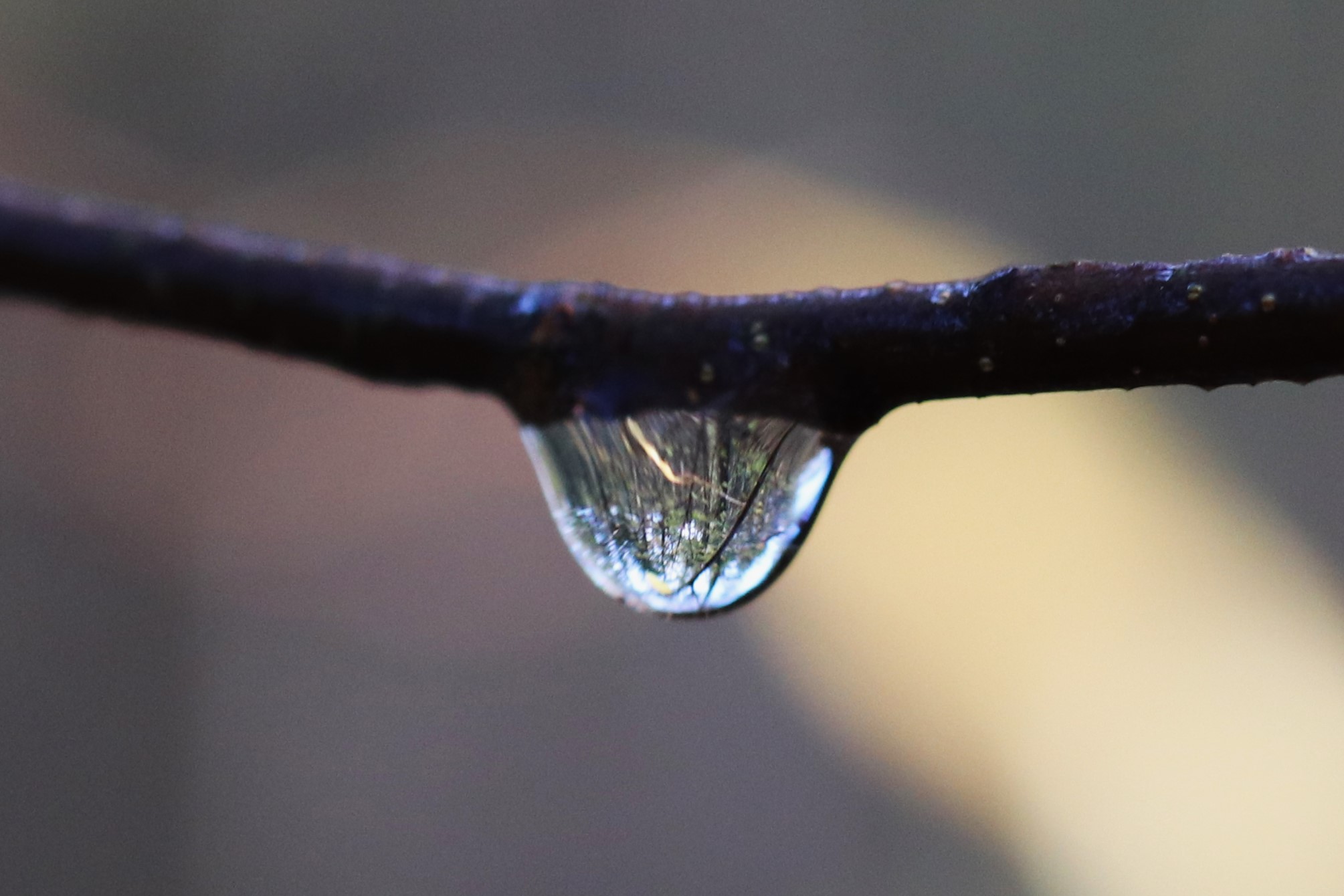
Water droplets show-casing inverted images of the surrounding forest.
After an earlier "missing persons incident" more clear directions were applied at a turn in the trail.

Most adult fireflies die before winter arrives. (It is the larvae that survive the cold weather by burrowing into the ground.) However, adult Winter Fireflies emerge in the fall and overwinter on the bark of trees. Adults have no "lanterns" and are diurnal, unlike most flashing fireflies. The larvae are bioluminescent.
https://www.inaturalist.org/taxa/125627-Ellychnia-corrusca

Trumpet Lichen growing alongside moss.

Oak Apple Gall: In the spring, a female wasp injects an egg into an oak-leaf bud. After the larva hatches, the gall structure begins to develop, protecting the immature wasp on the inside until it emerges as an adult in June or July. The gall is green and spongy at first. It becomes brown and papery after the adult emerges in the summer and eventually drops off the tree in the fall or winter. The empty gall case can provide shelter for other insects. Entire ant colonies have been found inside a single Oak Apple Gall!
https://newengland.com/living/gardening/oak-apple-galls/

Asian Ladybird Beetles taking shelter on some driftwood along the Lake Huron shoreline.

Friday, November 3, 2023

 Yard Finds!

Now that backyard feeders are again being stocked with seed, a good variety of species are frequenting the yard.

Northern Cardinals don't migrate and they don't moult into a dull plumage, so they're still breathtaking throughout the year!
https://www.allaboutbirds.org/guide/Northern_Cardinal/overview
Black-capped Chickadee checking to see if any one is home! (We haven't seen any sign of a Screech Owl in the box yet this fall.)
A patient female Downy Woodpecker waiting for her turn on the feeder. Its interesting to see the pecking order on the feeder each day!

Some birds are finding seed from our native garden such as these American Goldfinch on Blazing Star.

1st. year Chipping Sparrow eating seeds in the grass.

American Goldfinches feeding on Wild Bergamot

Praying Mantis lurking in the grass: After almost stepping on it, I let it crawl on my hand so I could take it to a nearby bush. As soon as it touched the leaves, it flew right back to where I first saw it. After mating and laying an egg case in the fall, the adults will die when the cold weather arrives.

Oleander Aphids really liked the Swamp Milkweed this year. They showed up later in the season. Although they will suck juice from the plant stems, they also provide food to many insects and some birds!

A surprisingly quiet Carolina Wren sat on a garden log.

Wednesday, November 1, 2023

 Henderson C.A. in October:

Fall was definitely in the air on a recent visit to Henderson Conservation Area with Canada Goose activity overhead.
Common Milkweed Seeds drying in the sun: New plant growth next summer will help Monarch caterpillars and butterflies.

Common Mergansers that didn't wait around for a good picture.

Double-crested Cormorants resting in the morning mist.

A Great Blue Heron enjoying the morning sun and probably hoping for a meal to swim past.
Common Sunburst Lichen

Sugar Maple Trees around the small pond never fail to impress with their brilliant autumn colours!

Sunday, October 29, 2023

Canatara Findings in October:

Praying Mantis' have been plentiful in Canatara Park this fall. This individual is waiting with outstretched "arms" for a meal to come by.
I watched a Praying Mantis eat a Honey Bee on Sweet White Clover. It wasn't until I looked at the pictures on my computer that I noticed a tiny fly in several shots. (underside of head) I later learned that Kleptoparastic Flies will swarm around a mantis with prey. Its good to learn something new every day!!

Red-bellied Woodpecker, male, in Dawn Redwood Tree (as suggested by iNaturalist). It is a deciduous coniferous tree, meaning it grows cones, but loses it's needles each year and is native to China. Canatara has a number of non-native species that were planted in years gone by. There is currently more focus on planting native trees in the park. 
https://www.inaturalist.org/taxa/69152-Metasequoia

Shiny Blue Bottle Flies, mating on October 24th.

The sunnier, warmer days have allowed turtles to bask in the sun which helps them to digest food more quickly. Gaining body fat increases their survival rate while spending time in the mud at the bottom of the water through the long winter. The technical term for turtle hibernation is "Brumation". Their metabolism slows down and they stop eating, but they aren't actually sleeping.
https://www.caringpets.org/how-to-take-care-of-a-turtle/hibernation-brumation-estivation/

Asian Ladybird Beetle on Wild Bergamot seed head. 

Friday, October 27, 2023

 Cooper's Hawks in Canatara!

I recently spent 15 minutes watching 2 Cooper's Hawks, hunt for food nearby. Dashing through vegetation to catch birds is a dangerous lifestyle. In a study of more than 300 Cooper's Hawk skeletons, 23 percent showed old, healed-over fractures in the bones of the chest, especially of the furcula, or wishbone.
https://www.allaboutbirds.org/guide/Coopers_Hawk/overview

Although catching birds in flight is their traditional hunting method and food source, the high population of Eastern Chipmunks in Canatara Park has provided Cooper's Hawks with an alternate source of food. Perhaps they break fewer bones from catching chipmunks on the ground than from plucking birds out of the air?

Cooper's Hawks nested for several years in the portion of Canatara known as Tarzanland. After a few year's absence, a successful nesting season in 2023 resulted in two young birds. Males typically build the nest over a period of about 2 weeks, with just the slightest help from the female. Nests are piles of sticks roughly 27 inches in diameter and 6-17 inches high with a cup-shaped depression in the middle.
https://www.allaboutbirds.org/guide/Coopers_Hawk/lifehistory# nesting

They have a remarkably long tail for their body size.
https://www.allaboutbirds.org/guide/Coopers_Hawk/overview
Both Cooper's Hawks are visible on the same limb.

The Hawk in the above photo set the chipmunk down and moved away. I didn't want to disturb it, so walked away but wonder if the second hawk came over for a meal? It would be interesting to know since I believe both birds are adults.