Friday, March 15, 2024

 Things With Tiny Wings!

Honey Bees have been very active on some of the warm days. I was impressed with the size of the pollen basket on the hind leg of this bee. They must be working hard to gather that much pollen at this time of year!

iNaturalist is suggesting this creature to be a Golden Dung Fly. Adults prey mainly on smaller insects. They also consume nectar and dung as additional sources of energy.
https://www.inaturalist.org/taxa/132718-Scathophaga-stercoraria

A Leaf-roller Moth

Dozens of Cellophane Bees flew just above ground level. They tend to be solitary, but sometimes nest close together in aggregations. Species in the genus build cells in underground nests that are lined with a cellophane-like plastic secretion!
https://www.inaturalist.org/taxa/127741-Colletes

While watching the Cellophane Bees, an "aptly named" Blood-winged Blister Beetle crawled past my feet.

An unknown insect hitched a ride on my hiking boot. It stayed with me for a few hundred metres before continuing on its own way.

Wednesday, March 13, 2024

 Chaos in the Tree Tops!

Invasive European Starlings are known to have a negative impact on cavity nesting birds. Some of the Red-bellied Woodpecker pairs in Canatara Park have recently been battling with the aggressive Starlings. The following series of photos were taken over a 30 minute period as the very stressed Woodpeckers desperately tried to defend their nest site.
The Starling appears to be biting the woodpecker's tail feathers in the last photo. Despite the aggressive behaviour of the Starlings, the Woodpeckers seamed to be winning the battle! I expect the woodpecker parents will need to be ever vigilant as they work to raise a new brood later this spring!

Sunday, March 10, 2024

 Things With LEGO Wings!

We visited Sean Kenney's Animal Super Powers LEGO exhibit in Windsor (LaSalle). The exhibition displays animals made from LEGO bricks and showcases the science behind their "super powers" that help them to survive in the wild. Open to public until April 6, 2024, Event Centre, Lasalle Landing. Trivia facts all taken from display signs. The Pileated Woodpecker was one of my favourite sculptures. Included in the 22,671 bricks was a spider at the tip of its beak!

Bald Eagles can see a fish in the water, a mouse in the field and can spot a rabbit from 2 miles away! (42,198 bricks used, 184 hours to build.) 

Mallard Drake taking ducklings for a walk. (Male Mallards typically have nothing to do with the care of ducklings.)

Because a caterpillar's primary goal in life is to fatten itself up for metamorphosis, it spends most of its time eating and can eat up 27,000 times its body weight during its lifetime! (46,950 bricks used, 438 hours to build!) 

Swallowtail Butterfly

Dragonfly eyes can capture up to 200 images per second while human eyes can see 60 images per second. Compound eyes allow them to see in several directions at once. (40,260 bricks used, 305 hours to build.) 

With 170 odour receptors in their antennae, bees' sense of smell is 50 times stronger than a dog's and 100 times stronger than a human's. (16,383 bricks used, 200 hours to build)

Ruby-throated Hummingbird

Dodo birds were amazing adapters. They didn't need to fly as they had very few predators. Over time, each generation developed smaller and smaller wings. When European settlers arrived to the island of Mauritius and changed the environment, the birds were no longer able to survive. The last Dodo died in 1662, less than 100 years after humans arrived. (75,000 bricks used, 668 hours to build.)

And A Few Things Without Wings!

Snow Leopard

Red-eyed Tree Frog

Mountain Goats

Tiny inverted LEGO men used to make the Goat's fur.

Friday, March 8, 2024

 Walking along the Sydenham!

I was very pleased to be invited to tour private property along the Sydenham River near Dresden on March 7th. The Sydenham River is one of the most species rich watersheds in all of Canada! We were able to walk along the river's edge which isn't possible in many sections. Previous high water levels were evident as we could see plant debris caught metres high up in trees.

The Sydenham River is home to 34 species of mussels, some of which were visible in shallow water close to the edge.

The inner shell of a Purple Wartyback mussel gleamed in the sun. It was found on land and is listed as a rare species in Ontario.
Although it was a sunny day, temperatures were still a little cool for insects. I headed over to the sap buckets to see what I could find. 
Lids on the pails may have deterred animals and birds, but insects were still able to enter, have a drink of sweet sap and then become trapped. I rescued the moth and a few of the lacewings. Many, many flies were also in the sweet sap.

Posted sign at the end of our walk. 
Definitely a tranquil spot!!

Tuesday, March 5, 2024

 Insects Marching 4th!

The temperatures on March 4th reached 20 degrees celsius locally and the insects were loving it. I found my first 2 Eastern Commas of the year. Hopefully they will find cover under logs or tree bark during the next cold spell.

A Common Boxwood bush that is just starting to flower attracted a number of insects including a Western Honey Bee. 

Member of the "Cluster Flies" Family.

Northern Paper Wasp (which had been on the Boxwood bush)

Asian Lady Beetle

Seven-spotted Lady Beetle

Sunday, March 3, 2024

 North Lambton Tour Feb. 25th.

We saw a few Bald Eagles flying overhead.

Hanging out with the Canada Geese in Port Franks was a Canada Goose hybrid. Notice the bird on the right side of the picture has an orange bill.

Although difficult to see, the Canada Goose in the centre has a white stripe along the top of its head. The leucism on this bird reminded me of an American Wigeon!

 Riverside Trail Boardwalk, Pinery Provincial Park.

A well-camouflaged juvenile Northern Pike: (Notice the narrow, light stripe along its back.) We could see its fins moving while it remained stationary under a thick layer of ice. 

White-breasted Nuthatch

Possible White Cheese Polypore.

Frosted fungus on a rotting log.

Ever curious and friendly, Black-capped Chickadee!

Thursday, February 29, 2024

 Leap Day Walk in Canatara Park!

The water was trying to "leap out" of Lake Huron in this morning's high winds.

The ever changing Lake Huron shoreline.

Most birds including this male Northern Cardinal stayed inland, sheltered from the wind.

Black-capped Chickadee watching passersby on the trail.

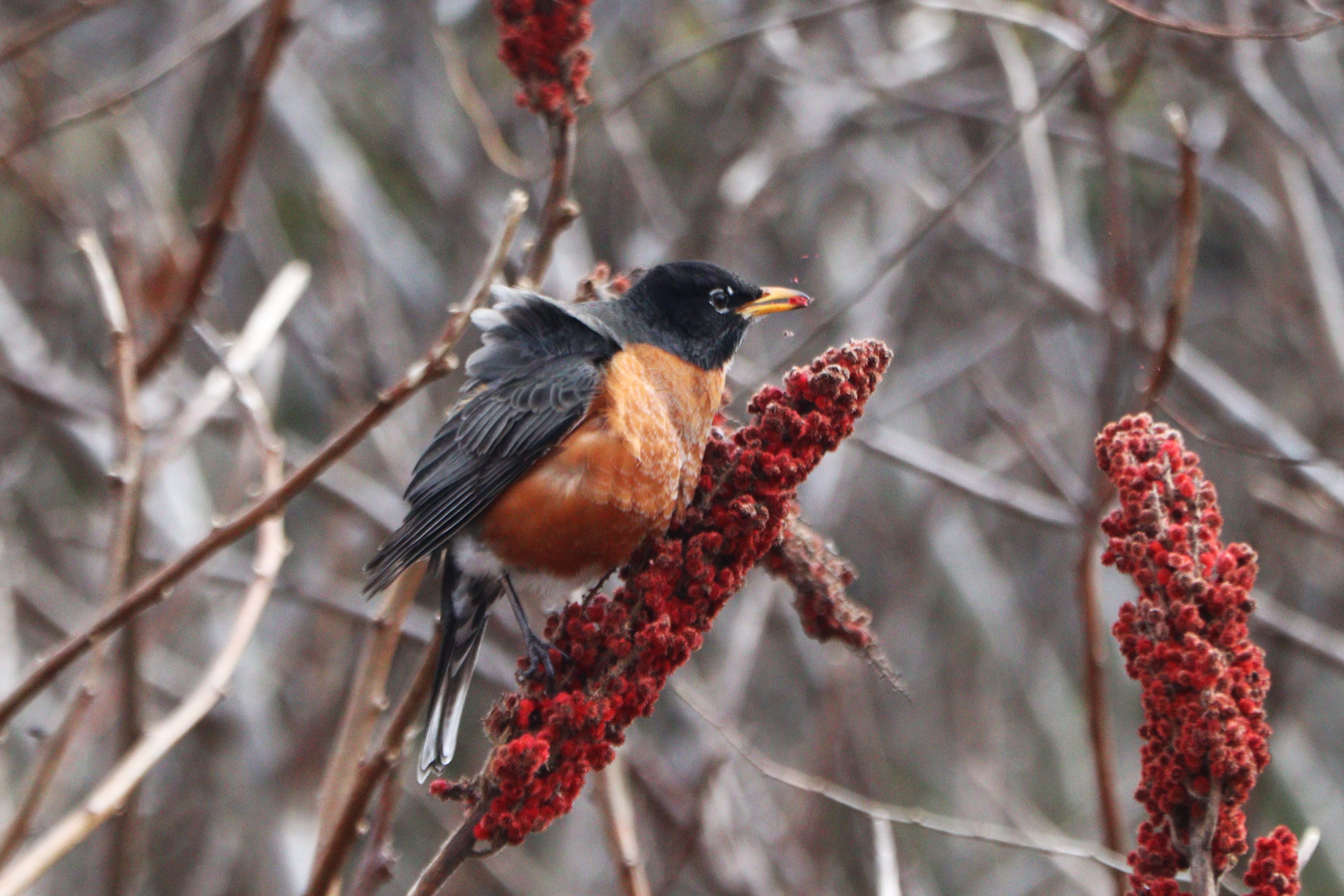
American Robins were busily eating sumac fruit. They were joined by Starlings, Grackles and Red-winged Blackbirds.

Grey Squirrel nibbling on tree keys

A Tufted Titmouse hunted for food on the forest floor. I would not have seen it if it hadn't started calling.